5 Graph Tech Predictions for 2026 according to the Experts
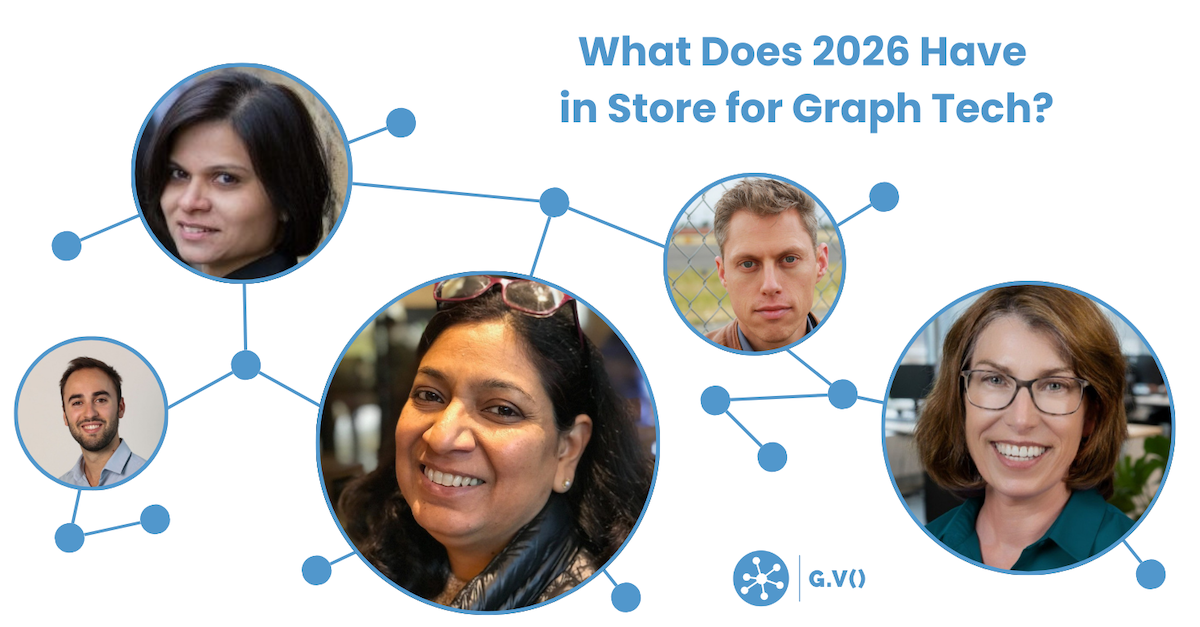
After the hustle and bustle of the holidays and the flurry of starting a new year, it’s the perfect time to examine what’s ahead for the graph technology industry.
No doubt 2025 was a busy year for graph tech, with concepts like GraphRAG, ontologies, context graphs, graph entity resolution, and more breaking out into the mainstream tech space. These hot trends were the moments in the spotlight that graph tech has desired – and deserved – for years, and now with the growing attention of the AI industry, graphs are poised to go even further.
To help frame this future with greater clarity, I asked five graph tech experts and practitioners across the industry what they believed was on the horizon for graph technology in 2026.
Here’s what they said: (in no particular order)
#1: Fewer Flashy AI Demos, More Graph Operationalization of Intelligence
by Luanne Misquitta, Neo4j
“The last few years were dominated by AI demos and proof-of-concepts: impressive, but often fragile. As organisations now push these systems into production, they’re running into hard constraints: lack of context, poor traceability, limited reasoning, and behaviour that becomes unpredictable at scale. This is where graphs are quietly reasserting their value.
“The graph platforms that have powered mission-critical applications for years are now becoming the semantic substrate of production-grade AI. Not because they ‘add intelligence’ on their own, but because they provide structure: explicit relationships, durable context, and a shared understanding of the world that AI models don’t retain. Rather than treating context as something to retrieve on demand, organisations are modelling it deliberately, using lightweight context graphs to anchor behaviour, memory, and decision-making over time.
“A pattern is crystallising across production deployments: graph technology as the structural layer that connects data, governs AI behaviour, and grounds agentic systems in verifiable reality. In 2026, success won’t come from who can demo fastest, but from who can operationalise intelligence reliably.”
Luanne Misquitta is the Head of Public Sector & Workforce Intelligence Solutions at Neo4j, the former CTO of cMatter, and the former VP of Engineering at GraphAware. She’s the co-author, with Christophe Willemsen, of Neo4j: The Definitive Guide published by O’Reilly Media.

#2: We’re Overdue for Innovation in Ontologies, Hypergraphs, & More
by Joshua Shinavier, Fortytwo Aero & Apache TinkerPop
“To those of us who have been working with ontologies for decades, it might be a little amusing that they are suddenly one of the hottest topics in AI. Old papers and books on ontology design are being dusted off and read with fresh eyes. However, this isn’t history repeating itself. The applications in which ontologies are being used today are dramatically different from those of twenty years ago, and the ideal solutions are likely to be different.
“There are many flavors of logic and knowledge representation, each giving rise to different requirements for ontology languages. Hypergraph data models are a great fit for the sort of record-structured data that is ubiquitous in the modern enterprise. Polymorphism and higher-order types are supported by nearly every programming language, but most ontology frameworks have yet to catch up.
“Meanwhile, we have barely scratched the surface of possibilities for automated reasoning, which can make our LLM-based solutions more efficient, more explainable, and more reliable. With this resurgence of interest in formal languages, there is an opportunity for deep innovation which will pay off in terms of the systems we can build in 2026 and beyond.”

Dr. Joshua Shinavier is a primordial being of the graph database domain and a co-founder of Apache TinkerPop™. Today, he is the Owner of Fortytwo Aero based in Santa Cruz, California, U.S. Over the last decade, Joshua has been working on the much-anticipated Hydra graph programming language.
#3: AI Will Categorically Embrace Graph Technology as Its New Foundation
by Maya Natarajan, node2node
“I think 2026 is the year when graph databases evolve into AI platforms. They’ll shift from being primarily graph query engines to serving as integrated GraphRAG and agentic AI foundations, bundling graph analytics, ML, and decisioning capabilities.
“Furthermore, graph technology will become the backbone of AI. Graphs are emerging as the knowledge layer that links data, events, tools, and rules for LLMs and agentic systems, enabling richer context and traceability.
“Also on the horizon is GraphRAG going from niche to default. GraphRAG is poised to become the natural successor to traditional RAG for handling complex reasoning tasks, particularly in tightly regulated domains like finance and healthcare.
“Finally, agentic AI will demand graph-native governance. 2026 will see roadmaps shift to a ‘governance first’ model, using graph-based trust layers to control what agents can do, what data they can see, and how they meet regulations.”
Dr. Maya Natarajan is the Founder of node2node helping graph tech companies with go-to-market strategy. She is also a Co-Founder of the State of the Graph project and the former Senior Director of Knowledge Graph Product Marketing at Neo4j.

The Boundary between RDF & LPGs Will Blur Even Further
by Amy Hodler, GraphGeeks
“Graph technology has just entered its Third Wave: The High-Utility Era. This follows a First Wave focused on knowledge capture and transfer (i.e., the Semantic Web) and a Second Wave centered on enterprise storage and transactions (i.e., labeled property graphs). The graph data model is no longer just a storage choice; it has become the fundamental ‘logic layer’ for automation and intelligence.
“As AI moves into production-scale agentic workflows, the focus is shifting toward hybrid approaches that incorporate contextual awareness and determinism. We are seeing a ‘combining of ideas’ where the technical walls between RDF and labeled property graphs (LPGs) are collapsing. For example, the Graph Data Council LEX Project, which integrates schema-first rigor and strong typing with high-performance property graphs.
“Growth will accelerate in big graphs with graph query engines over existing data lakes, and in ‘invisible graphs’ that are embedded in or serve applications both in and outside of AI. For AI practitioners, the era of ‘black box’ AI is ending and graphs will start providing the traceable reasoning paths and semantic contracts required for trusted, autonomous business operations.”

Amy Hodler is the Founder & Executive Director of GraphGeeks, an online community of graph tech and network science enthusiasts. She is the former Senior Director of Graph Evangelism at RelationalAI, the former Responsible AI Evangelist at Fiddler AI, and the former Senior Director of Product Marketing for Graph Analytics, Data Science and AI at Neo4j.
2026 Will See Massive Graph Adoption across Tech Stacks
by Arthur Bigeard, G.V()
“In 2025, we’ve seen the early signs of fundamental shifts in the graph database industry. Hyperscalers have released new DBaaS offerings for the first time in several years: Google Cloud Spanner Graph and Microsoft Fabric Graph.
“2026 will be a year of mass adoption: given the significant benefits graph technology is delivering for AI use cases and products, more and more teams will be pushed to include graph and/or semantic technologies of some kind in their tech stack.
“There’s been some major progress in the last couple of years, with the standardization of GQL, as well as the rise of graph on relational and embedded graph database solutions.
“Can the graph database industry lower barriers to adoption enough to deliver successful proof of concepts at scale? I’m feeling very optimistic about it – but we won’t just sit idly by. The G.V() team is going to continue building the tools that drive successful graph adoption and long-term use of graph technology. I’m certain of one thing: it’s gonna be a busy year.”
Arthur Bigeard is the CEO & Founder of G.V(). He’s a former VP at Morgan Stanley, and a former DevOps & Software Engineer at a number of companies. He created the G.V() graph database client and data visualization tool during the pandemic when he got frustrated with the state of Gremlin IDEs (they didn’t exist yet).

Conclusion
Predictions aside, one thing’s for sure: 2026 won’t be a boring one for the world of graph technology.
As more and more of the tech industry (and especially the AI space) discovers the potential of graphs, use cases and innovations will grow exponentially. After all, graph technology – including RDF, graph data science, ontologies, graph query engines, labeled property graph databases, and graph analytics – has always been at the heart of discovering new approaches, providing new solutions to old problems, and of course, making connections.
Ready to roll up your sleeves and join the graph tech revolution? Try out G.V() today and experience an IDE that helps you query, test, debug, explore, and visualize your connected data like never before.