
Databases
Amazon Neptune IDE and graph visualization tool
Connect gdotv to Amazon Neptune, then query, visualise and debug your graph in one workspace. Free three-week trial on Windows, macOS and Linux.
Get started
Easy installation and setup
Effortlessly integrate gdotv with your Amazon Neptune graph database with a simplified plug-and-play database connector. The gdotv database client provides straightforward database connection and configuration instructions to get you started in less than a minute.
This Amazon Neptune IDE is available to download for Windows, macOS and Linux, with a one-click installer to get you started instantly.
State-of-the-Art Gremlin and Cypher Editor
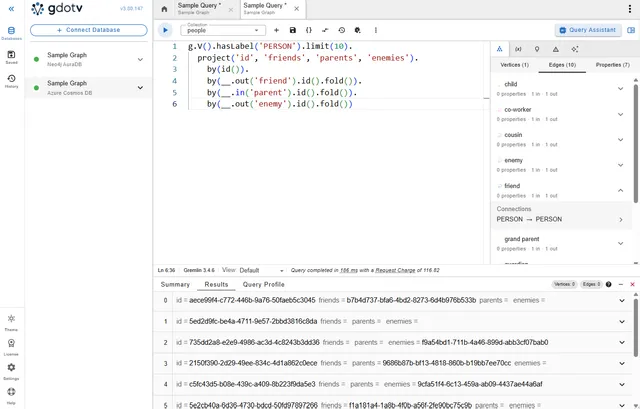
gdotv’s comprehensive Gremlin and Cypher query editor comes with syntax highlighting, autocomplete suggestions and built-in documentation. It also features the first ever Gremlin debugger
Explore, Manage and Modify your Graph
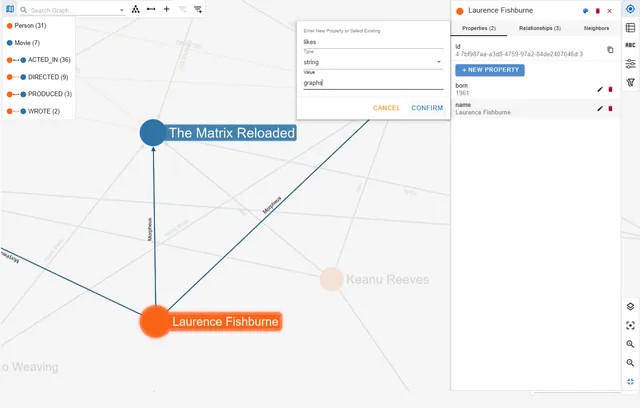
Effortlessly traverse your graph with the no-code Data Explorer, the data model view, interactive layouts, and customization panels to manage and even edit your graph on the fly.
Dashboards, Profiles and Visualization
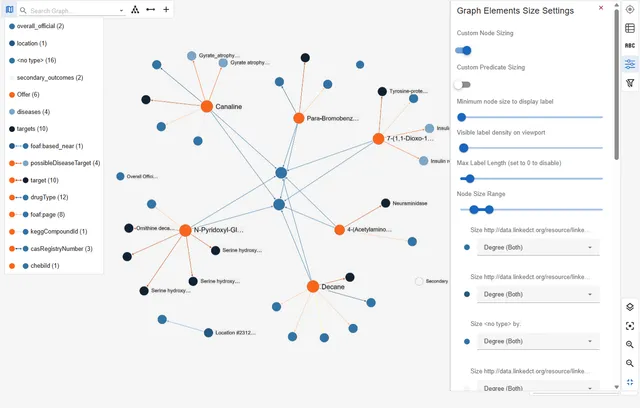
Communicate the most important elements of your graph using gdotv’s visualization and analytics tools, which are designed to convey key insights to both technical and non-technical audiences.
Try gdotv with Amazon Neptune
Query, visualise and model your Amazon Neptune data on your laptop, in your own cloud or across the whole team.
gdotv Desktop
The ultimate graph database IDE.
Install and connect your first graph database in 2 minutes.
gdotv Team
The unified workbench for graph data teams.
Deploy to your team in under 15 minutes. Marketplace or self-hosted.
gdotv Enterprise
The universal graph intelligence platform.
For organisation-wide deployments. Bring graph data directly to your analysts.
About Amazon Neptune
Amazon Neptune is a scalable, high-performance, AWS-managed enterprise graph database that allows users to build and analyze large volumes of data. It’s suited for highly connected datasets and offers millisecond-latency querying at a high throughput for the most demanding applications.
You can use gdotv to easily connect to your Amazon Neptune database, then perform essential day-to-day graph database development and management tasks such as querying, data analysis, data management, debugging, testing and visualization.
Learn more about Amazon Neptune in the Amazon Neptune documentation.
Already working in AWS graph-explorer? We put the two side by side, feature by feature, in our Amazon Neptune tooling comparison.
Frequently asked questions
What sets Amazon Neptune apart as a graph database?
Amazon Neptune is a feature-rich platform that supports both LPG and RDF graphs storage, giving it versatility in its ability to query a broad range of graph data formats.
With its support for multiple graph query languages, it eliminates the need to choose between the various graph standards and practices, instead letting you pick the storage model and language best suited to your requirements.
Being part of the AWS infrastructure ecosystem, it can also seamlessly integrate with other AWS services to further enhance its offerings such as AWS S3, AWS Glue, AWS Lambda and many more.
When to use Amazon Neptune graph visualization tools?
You can use gdotv with Amazon Neptune to create complex graph queries, debug, profile, execute them then analyze their output.
The insights can be used for fraud alerting, social networking, real-time recommendation engines, and much more. The applications for our graph database client are endless.
What graph data visualization scenarios do our customers implement?
Organizing data derived via powerful data visualization tools has several real-life applications. Graph visualization and analysis resources allow users to make informed decisions based on actual data. Here are a few examples of the type of companies or clients that can leverage Amazon Neptune analytics capabilities along with the robust data visualization aspect offered by gdotv:
Data scientists and managers: Visual data analysis allows users to uncover and understand emerging patterns and relationships between data points, discover valuable insights to make informed decisions on ways to transform business processes.
Cyber security groups: Build security graphs to represent protected assets, infrastructure, code dependencies or networks and visualize the connected relationships throughout the organization.
Business intelligence analysts: Create customized reports and visualizations that can be easily executed for analysts to investigate and communicate on interaction between business data points.
Fraud detection: Detect fraud patterns by modeling relationships between transactions and financial actors, then interactively visualize graph data to uncover and present potentially suspicious behavior.
How can I get started with Amazon Neptune and gdotv?
Getting started with Amazon Neptune and gdotv is easy. It’s just one simple installation, available on Windows, macOS and Linux. No prerequisites, additional configuration or installation required. You can get started in seconds.
gdotv automatically detects your connection setting requirements based on your database hostname and prompts you for the required information for an easy onboarding experience.
Want a step-by-step walkthrough? Make sure to check out our demo, Get Started with Amazon Neptune + gdotv on YouTube.
Why use Gremlin?
Amazon Neptune uses the Gremlin query language. Gremlin, being a traversal language, allows you to navigate the nodes and edges of your graph, filter them by their properties, and perform complex aggregations and pattern-matching operations to extract valuable insights.
It has a unique design that breaks from the convention of established languages such as SQL to provide a development experience tailored to the interconnected nature of graphs.
As an open-source framework, Apache TinkerPop benefits from the support of a large community of users, vendors and contributors that build on top of the project to provide enterprise-ready graph database implementations, complete with features such as index management and storage backend configuration.
What features does gdotv provide for Gremlin?
gdotv offers the first ever Gremlin Query Debugging functionality to analyze your graph traversals. Click here to see it in action!
You can use gdotv’s traversal simulation and report tools to gain a new perspective on your graph data.
In addition, gdotv’s Gremlin query editor also provides syntax highlighting, autocomplete suggestions and built-in Gremlin documentation to help you optimize your queries.
Why use Cypher?
Amazon Neptune supports the Cypher query language – the most widely adopted, fully-specified, and open query language for property graph databases. It provides an intuitive way to work with property graphs.
Cypher is a declarative query language specifically designed to handle querying graph data efficiently. With Cypher, you express what to retrieve but not how to retrieve it. This allows you to focus on the problem domain instead of worrying about the syntax.
Cypher was designed to be easy to learn but very powerful when it comes to graph analytics. This means that you can use Cypher to write complex queries relatively easily.
What features does gdotv provide for Cypher?
gdotv’s Cypher query editor provides syntax highlighting, autocomplete suggestions and built-in Cypher documentation to help you optimize your queries.
What’s the advantage of using LPGs over RDF?
Graph databases typically fall into two models: Labeled Property Graph (LPG) and Resource Description Framework (RDF).
The LPG model covers a broad class of databases, including Amazon Neptune, that use nodes, edges, properties and labels to represent graphs. They are optimised for real-time use and excel in applications like fraud detection, social network analysis and recommendation algorithms. There are also a wide range of methods to enforce schema compliance, with flexible conventions and definitions.
The RDF model refers to a highly standardized form of data management using global identifiers. Information is stored as a series of directed “triple” statements connecting a subject, predicate and object together. In addition, various languages built on RDF (such as RDFS and OWL) allow the construction of sophisticated ontologies and semantic reasoning. The high level of standardization also simplifies data integration from disparate sources. This makes RDF ideal for applications in large knowledge graph construction and research.
LPGs excel when performance and ease-of-use are a priority. Users typically find LPGs more intuitive, and they can be tailored to specific use-cases quickly and easily without the semantic complexity or steep learning curve of RDF.
How does gdotv secure my data?
gdotv Desktop runs locally on your device – no deployment needed and no handing over your data to a third-party system. Everything happens within your organisation’s network, and we have no access to your data.
Our Team and Enterprise versions run within your own environment, providing the same security benefits.
It’s easy to install and configure too: our setup wizard gets you connected to your graph database in seconds.
Can I connect more than one database at a time?
Yes! Whether you’d like to access multiple Amazon Neptune instances, or interact with other graph vendors at the same time, gdotv doesn’t limit you to a single database. You can establish as many connections as you like from within our intuitive UI, and seamlessly switch between them.
Connecting is easy, and there’s no need to manage multiple vendor specific user interfaces. With gdotv, query and compare results from all your RDF and Labeled Property Graph databases under one umbrella.
Related posts
All blog posts
gdotv Adds Multi-Graph Connections & Automatic Data Models [v3.74.142 Release Notes]
Discover multi-graph connections in gdotv v3.74.142: move between graphs, datasets and repositories on one connection, with data models that load themselves.
Pitting gdotv Against AWS Graph-Explorer (LPG)
How does gdotv compare against AWS graph-explorer? Follow along with this deep-dive as we explore the various features of each framework.
Building a Property Graph Pipeline from the TEG Benchmark: Part 4 – A Critical Examination of Text-Enriched Graphs
Read our critical analysis of TEG-DB: seven empirical findings on edge text quality, semantic entropy, and evaluation design gaps in text-enriched graph benchmarks.
Building a Property Graph Pipeline from the TEG Benchmark: Part 3 – Exploring with gdotv
Explore four queries in gdotv against TEG-DB show what edge text enables: sentiment polarity, citation chains, and contradictions invisible to graph topology.