Stylesheet Management
Introduction
Stylesheet Management allows you to modify the appearance of your graph results based on the label of the element (vertex, edge). Each element label found on your graph database will automatically be assigned a default style from the default stylesheet that will differentiate it from other elements. This is also applicable when new elements are introduced to the graph, as the data model for your database is automatically updated. For reference, see Data Model Management.
To modify the stylesheet, click on in the graph sidebar. Alternatively, when focusing on an element, you will be given an option to edit the element's stylesheet. You can also find this option from the Connection List sidebar by drilling into the Data Model.
Changes to the stylesheet are automatically applied to any opened graph results visualization.
Stylesheet Options
When editing the Stylesheet, you will be presented with the following window:
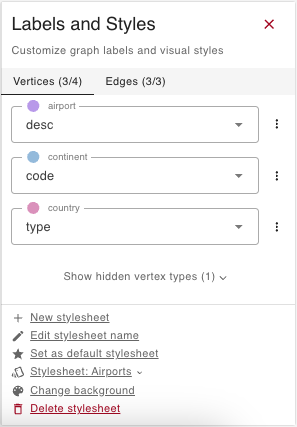
The following options are available for the stylesheet itself:
- New stylesheet : Create a new stylesheet
- Edit stylesheet name : Edit the name of the stylesheet
- Set as default stylesheet : Make the active stylesheet the default (only shows when the current stylesheet is not the default)
- Current stylesheet : The stylesheet to be used / edited
- Change background : The background color for the graph
- Reset all changes : Clear all unsaved changes to the current stylesheet
- Delete stylesheet : Delete the stylesheet (the original Generated Stylesheet cannot be deleted)
- Show hidden vertex/edge types: Shows all vertices/edges, rather than filtering out elements that are not currently showing on the graph
Vertices and Edges Options
You can edit the settings for each individual label:
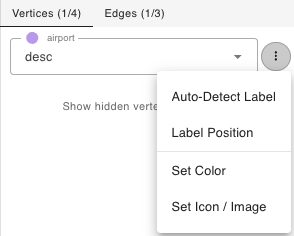
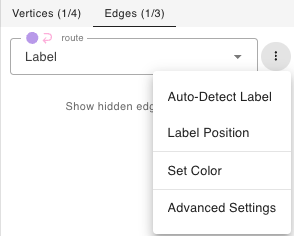
- Auto-Detect Label: See Label Suggestions
- Label Position: Select the position for the caption to appear in relation to the node circle / edge line
- Set Color: The color of the node circle / edge line
- Set Icon / Image: The background icon or image to be used for the node circle (Vertices Only)
- Advanced Settings: Brings up the advanced stylesheet menu (Edges Only)
Label Suggestions
Instead of having to select a caption for each individual label, gdotv can automatically detect and apply the most appropriate label from its properties.
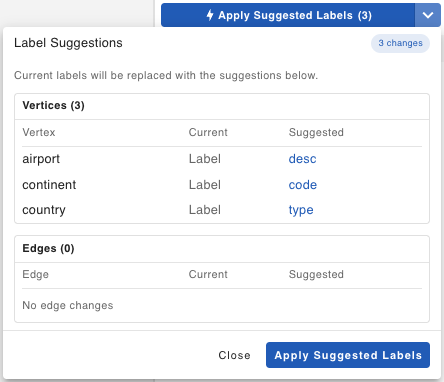
Click the arrow to view the suggested changes, and click on 'Apply Suggested Labels' to apply them. This will run for both vertices and edges (unless, like in this example, it decides the default 'Label' caption is most appropriate for all edge labels).
Suggested labels can also be set individually from each element's settings.
Captions
By clicking to expand the caption dropdown menu, you can select what the caption of your elements will be derived from. By default, it is set to the Label name, but there are many more options.
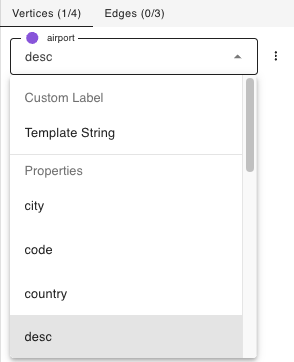
For each element, you can select any of the properties belonging to its label, along with some standard options, or create a custom label using a template string. For edges, this is expanded to include the properties of that edge's in and out vertex label.
Custom Labels
You now have the ability to create custom string label templates for vertex and edge labels. These can be built from a combination of properties and plain text, so you can fully customize each label.
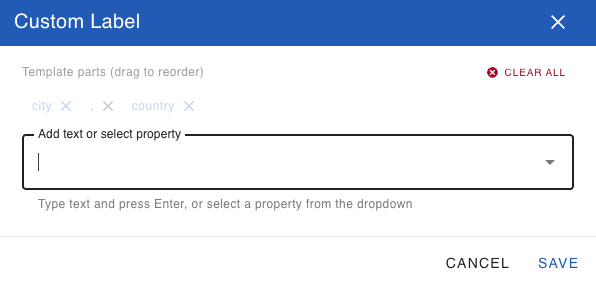
Advanced Edge Stylesheet Options
When editing an Edge's advanced settings, you will be presented with the following screen:
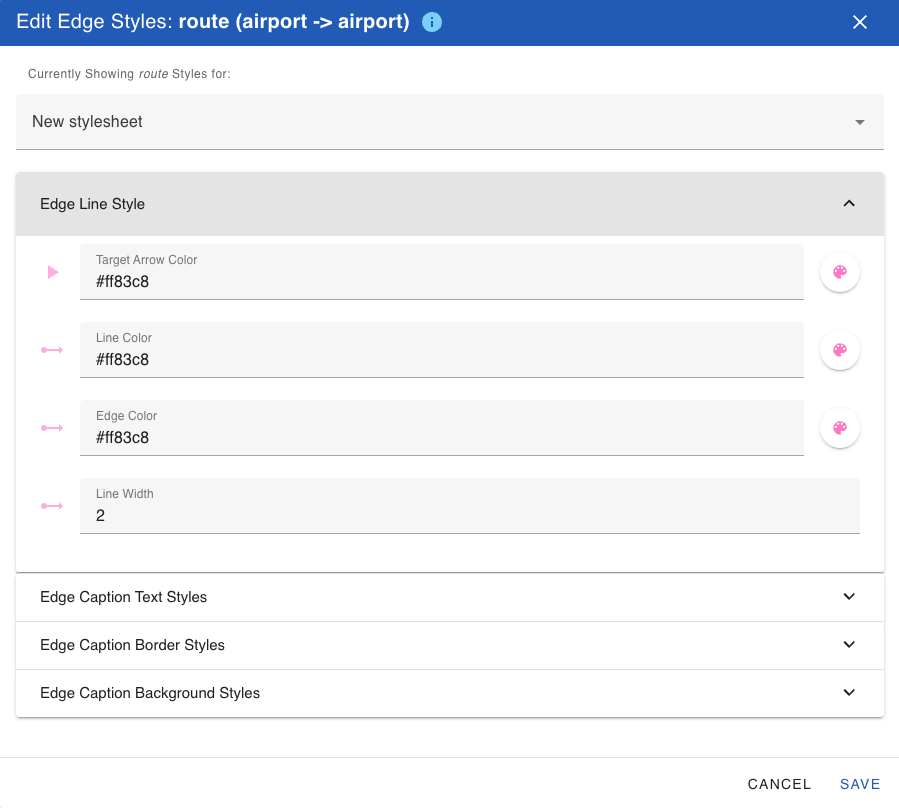
The following options are available:
- Edge Line Style:
- Target Arrow Color: The color of the edge’s target arrow
- Line Color: The color of the edge’s line
- Edge Color: The color of the edge
- Line Width: The width of an edge’s line
- Edge Caption Text Styles:
- Caption Text Value: The text as derived from the edge's properties to be displayed on the graph
- Caption Text Color: The color of the element’s caption
- Caption Vertical Alignment: The vertical alignment of an edge's caption; may be above edge, across edge, or below edge
- Caption Text Transformation: A transformation to apply to the caption text; may be none, uppercase, or lowercase
- Caption Font Size: The size of the caption text
- Edge Caption Border Styles:
- Text Border Width: The width of the border around the caption
- Text Border Style: The style of the border around the caption; may be solid, dotted, dashed, or double
- Text Border Opacity: The width of the border around the caption; the border is disabled for 0 (default value)
- Caption Text Border Color: The color of the border around the caption
- Edge Caption Background Styles:
- Caption Background Color: A color to apply on the text background
- Text Background Opacity: The opacity of the caption background; the background is disabled for 0