
The Weekly Edge: Practical Gremlin, Multimodal Graphs, Semantic Caching & More
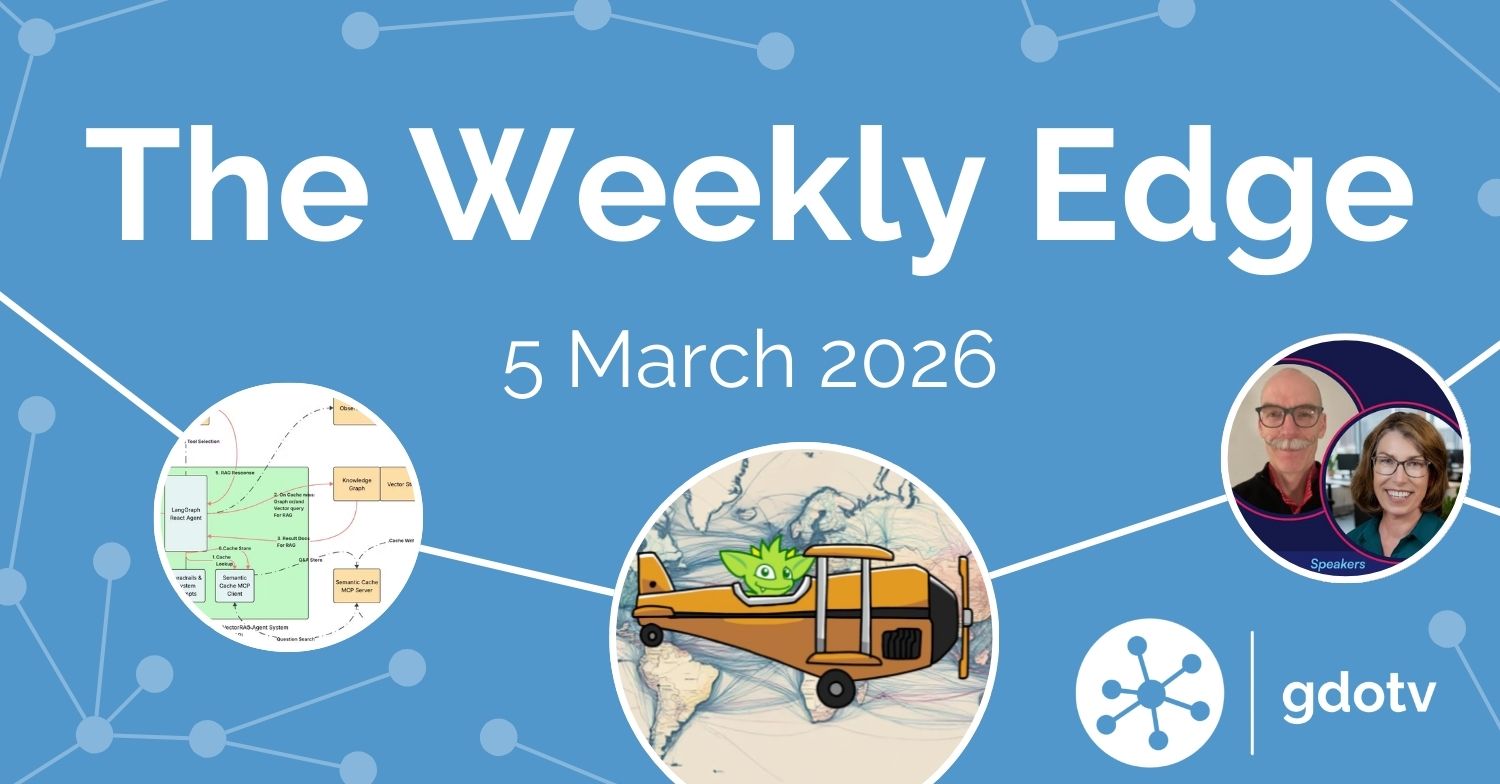
Welcome one and all to the first-ever Thursday edition of the Weekly Edge!
This regular series connects the nodes of news and knowledge across the world of graph technology in a tight (and funny?) tl;dr every week – curated by the team at gdotv.
Here’s a glance a this week’s headlines:
- Wholly writ, wholly practical: A new edition of the Gremlin Bible just dropped
- Take your GraphRAG multimodal: Integrating audio, images, video, and more
- Got a bad case of token burn? It’s time to try semantic caching
- Elon Musk hates this: One weird trick for better network science
- Typography sans silos: Explore a graph viz of typefaces, designers, and foundries
// It’s time to level up your graph game: Query, explore, edit, and visualize your connected data with the gdotv graph IDE. Try out the free dev tier or upgrade to a 1-month, no-fuss free trial.
Ready to dive in?
[News, Book:] Return of the Gremlin (for a 2nd Edition)

If you’ve ever used the Gremlin query language, you’ve probably referenced Practical Gremlin at least once. It’s basically the Gremlin Bible, and now Practical Gremlin is back with a second edition. The Apache TinkerPop™ graph computing framework isn’t a religion, but Kelvin R. Lawrence – sole author on the first edition and co-author of the second – certainly makes for one of its most compelling prophets. Long-time Gremlin evangelist Stephen Mallette joined him as a natural-fit co-author for the subsequent go around.
The second edition of Practical Gremlin is an evolving guide to the Apache TinkerPop Gremlin graph query and traversal language, built around real examples using real-world graph data. It’s written for developers and practitioners who want to learn Gremlin by doing, with a focus on practical patterns, working traversals, and lessons learned from applying graph technology to real problems.
What else is new in the second edition? For one, all of the examples were executed against Apache TinkerPop 3.8.0 (the most current version at the time of publication). But maybe more importantly, according to the official announcement, it’s also an ongoing edition. Going forward, the co-authors plan to automatically publish Practical Gremlin as a living book that’s continually updated as Apache TinkerPop evolves and as new content arrives. Sounds pretty practical to me.
[Watch:] Multimodal Graphs: Contextual Intelligence for Images, Text & Audio
For all their power, nuance, and skill, most AI solutions still can’t read the room – not unless they’re literally reading. Turns out most AI implementations are stuck in a text-only world, relying on flat vector searches that miss the deeper context found in visual and auditory data.
In this week’s watch, Amy Hodler and David Hughes explore the architecture of multimodal graphs and multimodal GraphRAG. While traditional retrieval-augmented generation (RAG) was a starting point, the real breakthrough lies in associative intelligence: the ability for a system to link disparate signals – a diagram, a spoken nuance, and a written report – into a unified, navigable world model.
In this recorded GraphGeeks livestream, David and Amy demonstrate how to treat images and audio not just as blobs of data, but as structured components of a graph that enable true contextual reasoning. Having gotten to watch their talk live at last year’s ODSC West, I can say this talk (and demo) will challenge how you think about data, knowledge, and intelligence and then show you how to build a better future.
//
[Read:] Optimize Your LLM Usage Costs with a Semantic Cache

Ever built an LLM tool so wonderfully powerful that you felt like you were flying only to come plummeting back down to earth when the API bill arrived? Birendra Kumar has been there, done that. Now he’s here to help you avoid the same Icarian mistake by reducing your token burn in production through the power of semantic caching.
Wait, what’s a semantic cache? It’s a cache which fetches entries based on the meaning of a piece of content or document instead of the hash of the key. So if two users ask similar questions but in different words, a semantic cache keeps the system from burning through extra tokens just to answer the second question from scratch – which matters a lot as the volume of questions scales.
Birendra’s semantic tech solution is labyrinthine but there’s a smart thread winding through it from start to finish that will make you appreciate the architect’s intentional choices. Along the way, he taps into the power of LangGraph, Redis, GraphRAG, VectorRAG, MCP, ChromaDB, and a Neo4j knowledge graph just to name a few. Not featured: a minotaur of an LLM API bill waiting for you at the end.
[Repo + Paper:] A Blue Start: A Higher-Order Dataset for Network Science

Network science (a cousin of graph theory) revolutionized the study of human behavior through its ability to represent complex relationships between individuals in a population. Modeling human social structures as a graph helps researchers understand how relationships form, the behaviour of highly networked individuals, interaction patterns at scale, and the nature of communities. It’s graphs but for people.
Twitter – apparently it’s “X” now – was once a place where a lot of that network science research took place. Eh, not so much anymore. In this week’s read-and-repo, a bunch of network science researchers published a paper titled “A Blue Start: A large-scale pairwise and higher-order social network dataset” to make their case for why it’s time for a new medium for social network analysis: Bluesky.
While the paper is still undergoing peer review, the five co-authors – Alyssa Hasegawa Smith, Ilya Amburg, Sagar Kumar, Brooke Foucault Welles, and Nicholas W. Landry – provided all of the code for reproducing their analyses and figures in the paper with an official GitHub repo of the data. Graph data scientists, dig in.
[For Fun:] A Graph Visualization of Typography

Type.lol started as a simple listing of typeface foundries, but now it’s a discovery platform that lets you browse typefaces from foundries and designers around the world – most uniquely as a network graph of typography.
While founder and designer Mark Johnson provides a number of ways for you to browse through data on typefaces, designers, and foundries, the graph visualization lens is a perfect example of how graphs help users explore and intuit connections quicker than ever before.
Be warned though: If the only three fonts you know are Arial, Times New Roman, and Calibri, this graph viz will probably blow your mind. But if you’re up for an adventure, strap on those serifs and dive into the typography graph. I’ll come pull you out after a few days.
P.S. While the gdotv team is hard at work on our next release, check out the dev previews for SHACL schema visualization and Apache HugeGraph connection support! 🦛
P.P.S. Watch this presentation by Christian Miles on the future of graph visualization in the age of AI from Data Day Texas – now on the gdotv YouTube channel! 🤠
P.P.P.S. Got an item to nominate for the next edition of the Weekly Edge? Hit us up at weeklyedge@gdotv.com. ✍🏽

![Cypher DISTINCT: Removing Duplicates from Results [Byte-Sized Cypher Series]](https://gdotv.com/wp-content/uploads/2026/02/distinct-clause-byte-sized-cypher-query-langauge-video-series.jpg "Cypher DISTINCT: Removing Duplicates from Results [Byte-Sized Cypher Series]")