Tag
Graph visualization
How to turn connected data into graphs people can actually read, with practical guides and expert insights from the team at gdotv.
78 posts
gdotv MCP server and graph data science [v3.88.151 Release Notes]
Query your graph in plain language through the new gdotv MCP server, run centrality and Louvain community detection on screen, and filter dashboards live.
EFFKG Review, Part 3: How to Score Knowledge Graph Referencing Quality
Score referencing quality in a public knowledge graph with RQSS, and see why 4 million EFFKG references resolving to 13 sources prove less than they look.
EFFKG Review, Part 2: 4 Queries That Expose the Fishing Fleet Graph
Explore the European Fishing Fleet Knowledge Graph with 4 SPARQL queries that return graphs instead of tables, and find where its structure runs out.
EFFKG Review, Part 1: How to Query the Fishing Fleet Knowledge Graph
Learn how to reach the European Fishing Fleet Knowledge Graph via its public SPARQL endpoint and an AWS Neptune import, and why the two copies disagree.
gdotv Adds Multi-Graph Connections & Automatic Data Models [v3.74.142 Release Notes]
Discover multi-graph connections in gdotv v3.74.142: move between graphs, datasets and repositories on one connection, with data models that load themselves.
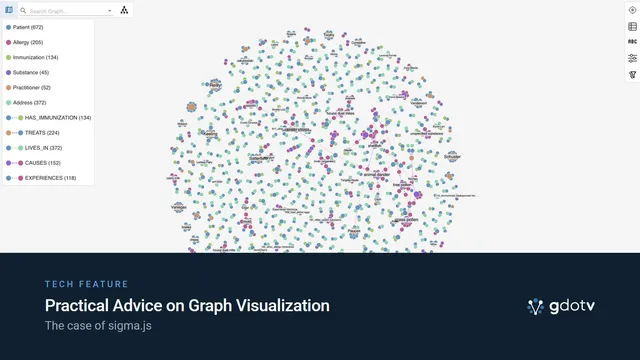
Practical Advice on Graph Visualization: The Case of SigmaJS
Explore how SigmaJS became the default engine for web graph visualization, the WebGL rendering tradeoff it solves, and why gdotv sponsors its development.
gdotv Now Supports pgGraph, Graph Queries on PostgreSQL
Explore pgGraph support in gdotv: connect to your PostgreSQL tables, write GQL graph queries, and visualize traversals and shortest paths with no migration.
Introducing pgGraph Support, Node Icons & Language-Aware Terminology [gdotv v3.63.137 Release Notes]
Discover gdotv v3.63.137: pgGraph support brings graph queries to PostgreSQL, plus node icons, language-aware vertex & edge terminology, RDF lang-tag grouping.
Pitting gdotv Against AWS Graph-Explorer (LPG)
How does gdotv compare against AWS graph-explorer? Follow along with this deep-dive as we explore the various features of each framework.
How does gdotv compare to Zazuko Graph Explorer?
How does gdotv compare against Zazuko Graph Explorer? Follow along with this deep-dive as we explore the various features of each framework.
Comparing gdotv vs GraphDB Workbench
How does gdotv compare against GraphDB Workbench? Follow along with this deep-dive as we explore the various features of each framework.
Working with JanusGraph? Here’s how gdotv compares to JanusGraph Visualizer
How does gdotv compare against JanusGraph Visualizer? Follow along with this deep-dive as we explore the various features of each framework.
Our solutions
Whether you're an individual or part of a larger team, there's a version of gdotv that's right for you.
gdotv Desktop
The ultimate graph database IDE.
Install and connect your first graph database in 2 minutes.
gdotv Team
The unified workbench for graph data teams.
Deploy to your team in under 15 minutes. Marketplace or self-hosted.
gdotv Enterprise
The universal graph intelligence platform.
For organization-wide deployments. Bring graph data directly to your analysts.