How does gdotv compare to Zazuko Graph Explorer?

Want the short version first? Our gdotv vs. Zazuko Graph Explorer comparison has the feature-by-feature table; this post is the long-form walkthrough.
Of all the comparisons in this series, this one requires the most careful framing of what each tool actually is before any feature-by-feature discussion can be meaningful. Zazuko Graph Explorer is not, strictly speaking, a user-facing application in the same sense as the other tools reviewed in this series. It is a JavaScript library and embeddable component designed to bring RDF graph visualization to SPARQL endpoints, Linked Data publishers, and web applications. gdotv is a developer-grade desktop client for writing, debugging, and visualizing graph database queries across a wide range of backends. They share a common territory: both work with RDF data, both render interactive graph visualizations, and both connect to SPARQL endpoints. Beyond that, their intended users, deployment models, and feature priorities are quite different. This post explains where those differences matter and how to decide which one belongs in your workflow.
The Tools at a Glance
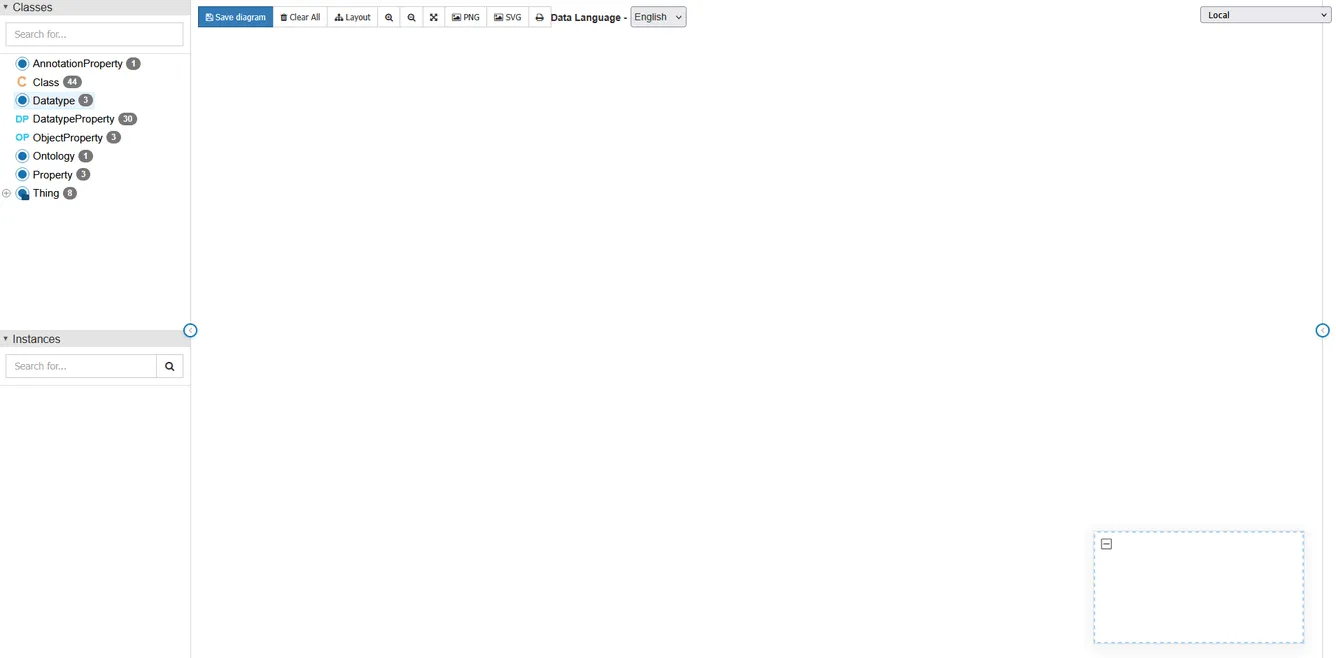
Zazuko Graph Explorer is an open-source JavaScript application and library, MIT licensed and actively maintained by Zazuko GmbH, a Swiss company with a deep focus on Linked Data and the semantic web. It is a fork of Ontodia, itself now part of the commercial Metaphacts platform. By forking the codebase, Zazuko has kept an open-source path alive and continued extending it for the Linked Data publishing context. Graph Explorer is designed around visual navigation of RDF knowledge graphs: users explore data by clicking through a class tree, expanding node connections on a canvas, and following links across the graph. It connects to one or more SPARQL 1.1 endpoints and can also load RDF resources directly from the web by URI. It ships as part of Zazuko’s Trifid server alongside YASGUI for SPARQL querying and SPEX for schema introspection, and it can be embedded as a component in any web application. There is no SPARQL query editor in Graph Explorer itself.
gdotv is a multi-database graph client built for developers and data engineers. It connects to any RDF triplestore via SPARQL, alongside a wide range of LPG databases. Its SPARQL editor provides syntax validation, schema-aware autocomplete, query formatting, query parameters, and real-time ontology-aware validation via the Query Guardrails feature. Graph visualization, no-code exploration, and multi-panel dashboards sit on top of that query-first foundation. It runs as a desktop application or EC2 instance and does not embed into other applications.
Feature Comparison at a Glance
| Dimension | gdotv | Zazuko Graph Explorer |
| SPARQL query editor | Yes — full editor with autocomplete, validation, formatting | No — not included |
| SPARQL query types | ASK, SELECT, DESCRIBE, CONSTRUCT, UPDATE | N/A (no editor) |
| Ontology-aware guardrails | Yes — real-time semantic validation | No |
| RDF graph visualization | Yes — multi-layout, interactive, editable | Yes — primary purpose, canvas-based |
| Multi-endpoint configuration | Yes — per connection | Yes — configurable across endpoints |
| Load RDF resources from the web | No | Yes — fetch RDF by URI from the web |
| Diagram export (PNG/SVG) | Yes | Yes — SVG and PNG export |
| No-code data exploration | Yes — Graph Data Explorer with path patterns | Yes — visual class tree and link expansion |
| Class tree navigation | No | Yes — browse by RDF class hierarchy |
| Embeddable as JS library | No | Yes — designed to be embedded |
| Domain model / schema view | Yes — OWL/RDFS/SHACL unified | Partial — schema inferred from data |
| Dashboards and charts | Yes — multi-panel visual analytics | No |
| Data editing (add/delete/modify) | Yes | No |
| Multi-database support | Yes — Neptune, Stardog, GraphDB, etc. | Any SPARQL 1.1 endpoint |
| LPG database support | Yes — Gremlin, Cypher, openCypher | No — RDF only |
| Open source | No — commercial with free trial | Yes — MIT licensed |
| Deployment | Desktop app (local/EC2) | Embedded in Trifid or standalone JS app |
| Pricing | Commercial (free trial) | Free and open source |
SPARQL Support — A Fundamental Split
The most consequential difference in this comparison is straightforward: Zazuko Graph Explorer has no SPARQL query editor. It consumes SPARQL internally to power its visual exploration, but users never write a query. The tool is built entirely around visual, click-driven navigation of the graph. If your use case involves writing, testing, or refining SPARQL queries against an RDF endpoint, Graph Explorer does not serve that need at all. When Zazuko deploys Graph Explorer as part of their Trifid stack, they pair it with YASGUI for SPARQL querying and SPEX for schema introspection. These three tools together cover the full workflow: YASGUI handles query writing, Graph Explorer handles visual exploration, and SPEX introspects the data model. The point is that Graph Explorer is one component in a toolchain, not a standalone all-in-one client. gdotv covers that entire toolchain in a single interface. Its SPARQL editor, schema visualization, and graph explorer are integrated and share the same underlying Domain Model built from the dataset’s OWL, RDFS, and SHACL metadata. For a developer who wants one tool that can query, validate, visualize, and explore an RDF triplestore without assembling separate components, gdotv provides that unified experience. For a team publishing Linked Data and wanting to give end users a visual browser without exposing a query interface, Graph Explorer’s component-first design is more appropriate.
Graph Visualization — Shared Ground, Different Purpose
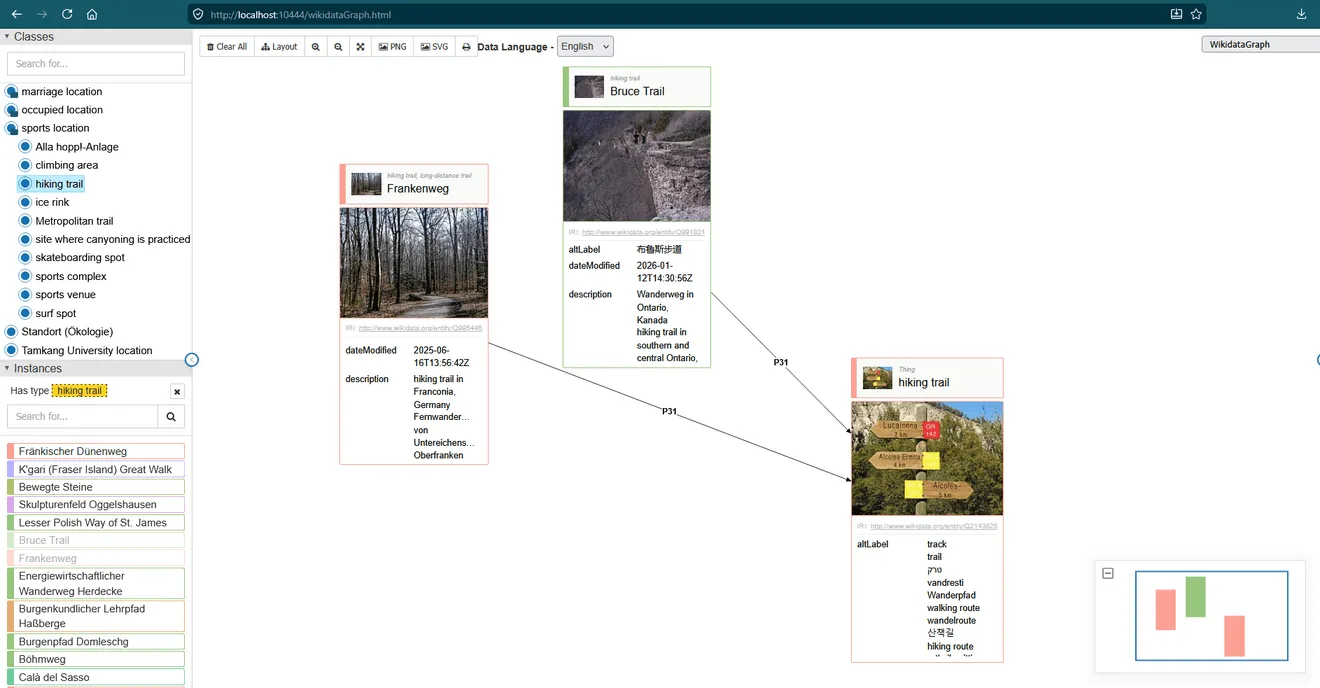
Both tools render interactive graph visualizations of RDF data, and this is where they overlap most meaningfully. The experience, however, reflects their different audiences. Zazuko Graph Explorer’s visualization is canvas-based, presenting RDF entities as styled cards rather than raw node-and-edge circles. Users navigate by browsing a class tree on the left side of the interface, selecting entities to place on the canvas, and then expanding their connections. Links between nodes can be filtered by type, and the diagram can be exported as SVG or PNG for documentation or presentations. The tool can be configured to connect to multiple SPARQL endpoints simultaneously, which makes it well-suited for Linked Data environments where a single knowledge graph federates across several sources. Because Graph Explorer is a JavaScript library, organizations can embed it directly into their own web applications, portals, or knowledge management tools with a custom look and feel. This embeddability is a genuine capability that gdotv does not offer.
gdotv’s visualization is more analytical in orientation. It supports multiple configurable layout algorithms, inline editing of node and edge properties, IRI prefixification for readable labels, and a no-code Graph Data Explorer that allows path-based traversal using property filters and label selection rather than a class tree. Its Dashboard feature adds a layer that Graph Explorer does not address at all: multi-panel analytical views combining graph visualizations, charts, gauges, Sankey diagrams, and tables in a single composable workspace. For teams communicating insights from RDF data to stakeholders, or building repeatable analytical views for operational monitoring, this fills a gap that a pure visualization library cannot.
Linked Data Publishing and the Open Web
One of Graph Explorer’s distinct capabilities is its ability to load RDF resources directly from the web by URI rather than requiring a locally configured SPARQL endpoint. In a true Linked Data context, where resources are published with resolvable IRIs that return RDF on content negotiation, Graph Explorer can follow links across the open web and visualize the resulting graph. This reflects Zazuko’s deep roots in the Linked Data community and makes Graph Explorer a particularly natural fit for scenarios involving publicly accessible knowledge graphs, government open data portals, or research data published as Linked Data.
gdotv does not load RDF resources from the web by URI. It connects to configured endpoints and works with the data returned by queries. For organizations operating in a closed enterprise triplestore environment this is entirely sufficient, but for teams working with public Linked Data or building browsers over open web data, Graph Explorer’s web-traversal capability has no equivalent in gdotv.
Open Source, Embedding, and Extensibility
Zazuko Graph Explorer is MIT licensed, free to use, and extensible. Organizations can fork the codebase, contribute features, customize the visual style, and embed the library into their own applications. The Trifid server in which it commonly ships is also open source, meaning a complete Linked Data publishing stack with SPARQL proxy, query interface, schema browser, and graph visualization can be assembled entirely from free, open-source components. For academic institutions, public sector data publishers, and research projects with limited budgets and a preference for open tooling, this is a significant practical advantage. The embeddability of Graph Explorer deserves particular attention for development teams. Because it is a JavaScript library, it can be integrated into an Angular or React application, a knowledge portal, an internal wiki, or a domain-specific data browser with custom templates and styling. The parent Zazuko Blueprint project extends this further, providing an enterprise knowledge graph frontend that uses Graph Explorer as one of its visualization components. gdotv offers no equivalent embedding path. It runs as a standalone application and is not designed to be integrated into other tools. gdotv is a commercial product with a free trial. Its cost is a real consideration, particularly for open-source or academic projects. What it offers in return is a richer and more complete developer experience out of the box: no assembly of components required, no infrastructure to configure, and a depth of query tooling that goes substantially beyond what Graph Explorer provides.
Database Scope
Zazuko Graph Explorer connects to any SPARQL 1.1-compliant endpoint. It is RDF-only in its data model and has no concept of LPG databases, Gremlin traversals, or openCypher queries. For teams working exclusively in the RDF and Linked Data world, this is entirely appropriate. For teams that also work with property graph databases like Neo4j, Amazon Neptune in LPG mode, or JanusGraph, Graph Explorer is not relevant to that part of the stack. gdotv connects to all major RDF triplestores as well as a wide range of LPG databases, covering Gremlin, Cypher, openCypher, GQL, and more under one interface. For teams operating at the intersection of the semantic web and the property graph worlds, as is increasingly common in enterprise knowledge graph projects, this cross-model support is a practical convenience that eliminates the need for separate tooling.
Pick This If…
Choose Zazuko Graph Explorer if your goal is to provide a visual RDF graph browser to end users who should not see or write SPARQL queries. It is the right choice for Linked Data publishers who want to give the public a way to navigate their open data, for development teams embedding a graph visualization component into a web application or knowledge portal, and for academic or open-source projects that need a free, extensible, and embeddable visualization library. Its ability to traverse the open web and load RDF by URI makes it particularly well suited to true Linked Data environments. Pairing it with YASGUI in a Trifid stack gives you a complete open-source solution for publishing and exploring RDF data.
Choose gdotv if your primary need is a developer-grade client for writing, validating, and exploring SPARQL queries against RDF triplestores, with graph visualization built in. If your team works across multiple database technologies, gdotv’s unified interface saves context-switching overhead. If semantic query validation matters, the guardrails feature addresses a gap that Graph Explorer’s component-based approach was never designed to fill. And if self-contained multi-panel dashboards for communicating graph analytics are part of your workflow, gdotv covers that without requiring external tooling.
Audience note: For Linked Data publishers and open data teams building public-facing knowledge graph browsers, Zazuko Graph Explorer is purpose-built for your context and requires no commercial spend. For semantic web researchers who need to both query and visually explore RDF datasets, Graph Explorer covers the exploration side but will need to be paired with a SPARQL editor. gdotv provides both in a single tool. For front-end developers building applications over RDF data, Graph Explorer’s embeddable library model is far more practical than trying to integrate a desktop client. For data engineers writing and maintaining SPARQL in a production environment, gdotv’s query tooling is the more complete and productive environment by a wide margin.
Bottom Line
Zazuko Graph Explorer and gdotv answer genuinely different questions. Graph Explorer asks: how do we make RDF data visually accessible to users who cannot or should not write SPARQL? gdotv asks: how do we give developers and data engineers the most productive environment for working with graph databases? Those two questions rarely need the same answer.
For most engineering teams building with RDF, the two tools are complementary rather than competing. Graph Explorer serves the front-end and publishing layer, making graph data browsable for end users and domain experts. gdotv serves the development and analytics layer, supporting the engineers who build and maintain the underlying data pipelines and query logic. If you are choosing between them for a single purpose, the decision comes down to whether that purpose is visualization and publishing on one hand, or query development and analysis on the other.
About the author

Dr. Seyed Amir Hosseini Beghaeiraveri
Data Scientist
Amir holds a PhD in Computer Science from Heriot-Watt University and recently completed his postdoctoral fellowship in Large-Scale Nested Data Processing at the University of Edinburgh's School of Informatics. He brings several years of experience in graph-based structures and semantic web technologies to the team, with a focus on data processing and validation. As a long-time RDF user, he leads the continuous design and implementation of solutions for RDF/SPARQL users at gdotv.