The Yearly Edge: All the News Nodes & Relationships That Shaped Graph Tech in 2025
Welcome to a special edition of the Weekly Edge. Rather than recapping the last 7 days (or so) of graph tech news, we’ll take a step back and look at the year as a whole. That’s right, it’s time for the first-ever Yearly Edge!
This edition is your tl;dr of all the major events that shaped the world of graph database technology – the good, the bad, and the graphy – in the past 365 days (or so), curated as always by the team at G.V().
Here are the top graph headlines that shaped 2025:
- Better at long last than never: Google joined the graph game 🔧
- One small step for graphs: RDF 1.2 continued its giant leap toward standardization 🧑🏼🚀
- LDBC no more: The Graph Data Council has spoken 🥸
- Adieu, Kuzu: The sixth stage of grief is creating a fork 🐦🔥
- Saved by the wizard: Dgraph lives on under the protection of Istari Digital 🧙🏽
- Just getting started: A look at the graph projects that dared to think different in 2025 💡
Shall we reminisce?
[Release:] Google Spanner Graph Goes GA
The year kicked off with a bang led by the general availability of Google Cloud Spanner Graph in late January. The cloud graph database, under the leadership of Bei Li, had been launched in preview five months earlier, making Google the last major cloud player to introduce a graph database offering (behind Oracle Graph, Amazon Neptune, and Microsoft Azure Cosmos DB).
But better late than never: Spanner Graph opens up worlds of connected data analysis to Spanner users and customers, offering graph data management alongside relational, search, and AI capabilities, all on a single unified, highly scalable database. Of course we’d be remiss not to mention that G.V() is a founding Spanner Graph graph visualization partner. 😏
[Reconfig:] RDF 1.2 Standard Makes Steady Progress
The world of Resource Description Framework (RDF) technology might move slowly at times, but like a glacier, it does so with strength that shapes landscapes. Last April, the World Wide Web Consortium (W3C) published its group draft note of the RDF 1.2 standard, which was (and is) a big deal.
While it’s still technically a work in progress, draft RDF 1.2 standard maps out where the W3C sees RDF going in the near future – so users and vendors can prepare accordingly. For those of you who don’t follow the minutiae of standards body by-laws, this is just one of many steps towards full standardization, but it’s an important one. The current standard – RDF 1.1 – was last formalized in 2014, so it’s high time for the much-anticipated 1.2.
Also in RDF news this year: The International Semantic Web Conference (ISWC) held last November pointed to important sea-changes in the space (here’s our recap), and G.V() now officially supports 11+ different RDF and SPARQL tools to help you keep doing your best work with graphs. 💪🏽
[Rebrand:] The LDBC Becomes the Graph Data Council
In early September 2025, the Linked Data Benchmark Council (LDBC) officially became the Graph Data Council (GDC). The motion to rebrand the organization was adopted to reflect the broader ambition of the council within the graph world, which goes far beyond just benchmarking, spanning both RDF and LPG systems.
Like a boss, the GraphGeeks team covered the hows and whys of this rebrand in robust detail.
First up, Dennis Irorere, Director of Innovation at GraphGeeks, created an awesome write-up about the recent GDC Technical User Community meeting in London, detailing not only the reasons behind the GDC rebranding but also the continued work on the Graph Query Language (GQL) standard, the paradox of growing demand for graphs, and a hat tip to a talk given by G.V() Supreme Leader Arthur Bigeard (all hail). Catch the full agenda, slides, and recordings here for all the deets.
Following on, Amy Hodler, Executive Director of GraphGeeks, spoke with Henry Gabb, Chair of the Graph Data Council, for a deep dive into the world of vendor-neutral graph benchmarks, standards, and innovation. Among other topics, they discuss how the GDC is expanding its focus beyond traditional benchmarks like FinBench and Graphalytics to embrace microbenchmarks, synthetic data generation, and the exciting work being done on LEX schema to potentially unify property graphs and RDF. 🤯
[Reincarnation:] Kuzu Died But Its Embeddable Spirit Endures
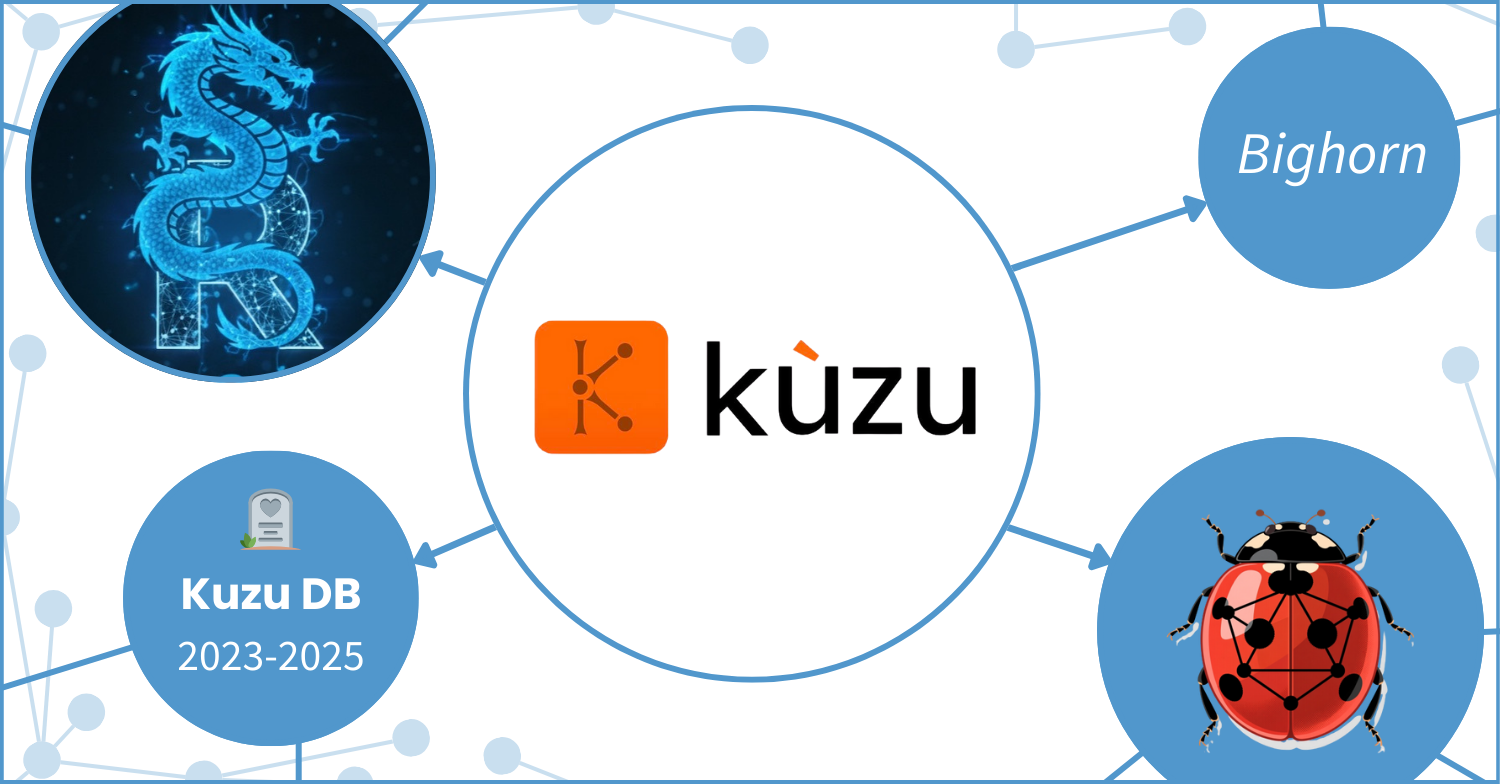
Friends, graph geeks, engineers, lend us your nodes: We come to archive Kuzu, not to fault it. The forks that devs do live after them; the source is oft interred with their repos – so let it be with Kuzu.
On October 10th, Kuzu DB was quickly and quietly archived on GitHub, and immediately afterwards, there was a great disturbance in the graph tech ecosystem, as thousands of voices suddenly cried out in terror and then shared their reactions on LinkedIn (including us). Something terrible had happened: the world’s only embeddable graph database at the time had disappeared without warning.
But it wasn’t all panic at the graph disco. Lots of people paid loving tribute to what the Kuzu team – including Semih Salihoğlu, Ardan Arac, Prashanth Rao, and many others – had built over the years and the trails that Kuzu had blazed.
For a moment, it felt like the graph tech world was in the Bad Place. But in the month that followed, the graph community rallied around the remains of the beloved/embedded graph database and a number of forks of the original Kuzu project were announced. Here’s a closer look at the top three most popular Kuzu forks:
Bighorn
Within the first week, the good folks at Kineviz announced a Kuzu DB fork, dubbed Bighorn, which they’ve pledged to develop and maintain as open source. The Bighorn fork is supported by GraphXR as both an embedded database and stand-alone server modes.
Ladybug
A short while later, Arun Sharma (ex-Facebook, ex-Google) announced the launch of Ladybug, a community-driven fork of the Kuzu repo but with a vision to be a full one-to-one replacement of Kuzu in the long term. Learn about Ladybug at their website or on GitHub. For even more of the story, catch my Graph Chat video with Arun Sharma at ODSC.
Also of note: Ladybug is fully supported for use with G.V().
RyuGraph
Before a month had passed, Akon Dey, former CEO of Dgraph, announced the launch of RyuGraph as a third major fork of Kuzu. According to Akon’s official announcement on LinkedIn, RyuGraph had been months in the making as part of a larger data system built for enterprise use cases. Amy Hodler from GraphGeeks also caught up with Akon Day for a Graph Chat about RyuGraph if you’d like to learn more.
I’m excited for all of the Kuzu forks, but for me personally this one wins in the “bad-ass name” category. Just like Ladybug, RyuGraph is fully supported by G.V().
–
The best part of the graph community is our ability to connect, collaborate, and commit to the good of the ecosystem, and all of these Kuzu forks – along with others – keep those values alive. We’re sure there’s more good news to come from these projects in 2026, so watch this space!
In the meantime, let’s pour one out for the OG embeddable graph database. Kuzu was named after the Sumerian word for wisdom, so it’s fitting that now we say “silim,” Sumerian for goodbye. 😢
[Resurrection:] Dgraph Returns from (Almost) Certain Death
In late October, more graph database news hit our feeds: The Dgraph graph database had been officially acquired by Istari Digital. (Yes, that Istari 🧙🏼♂️, we can only assume.) Following the announcement, Maggie Johnson-Pint, VP of Product & Engineering at Istari Digital, assured community members on the Dgraph Discord: “Our first priority at Istari is to ensure that Dgraph is a well-maintained project for the community.”
To be sure, this news came as a breath of fresh air for the Dgraph community. Back in 2023, Dgraph’s acquisition by Hypermode had left many developers in its open source community wary and worried about the project’s future. The acquisition by Istari ensured a reliable future for the written-in-Go graph database which has built up a highly dedicated fan base over the years. While Dgraph might not have technically died, its acquisition almost certainly feels like a resurrection. 😇
[Ready to Rock:] Early Graph Innovations Got Started in 2025
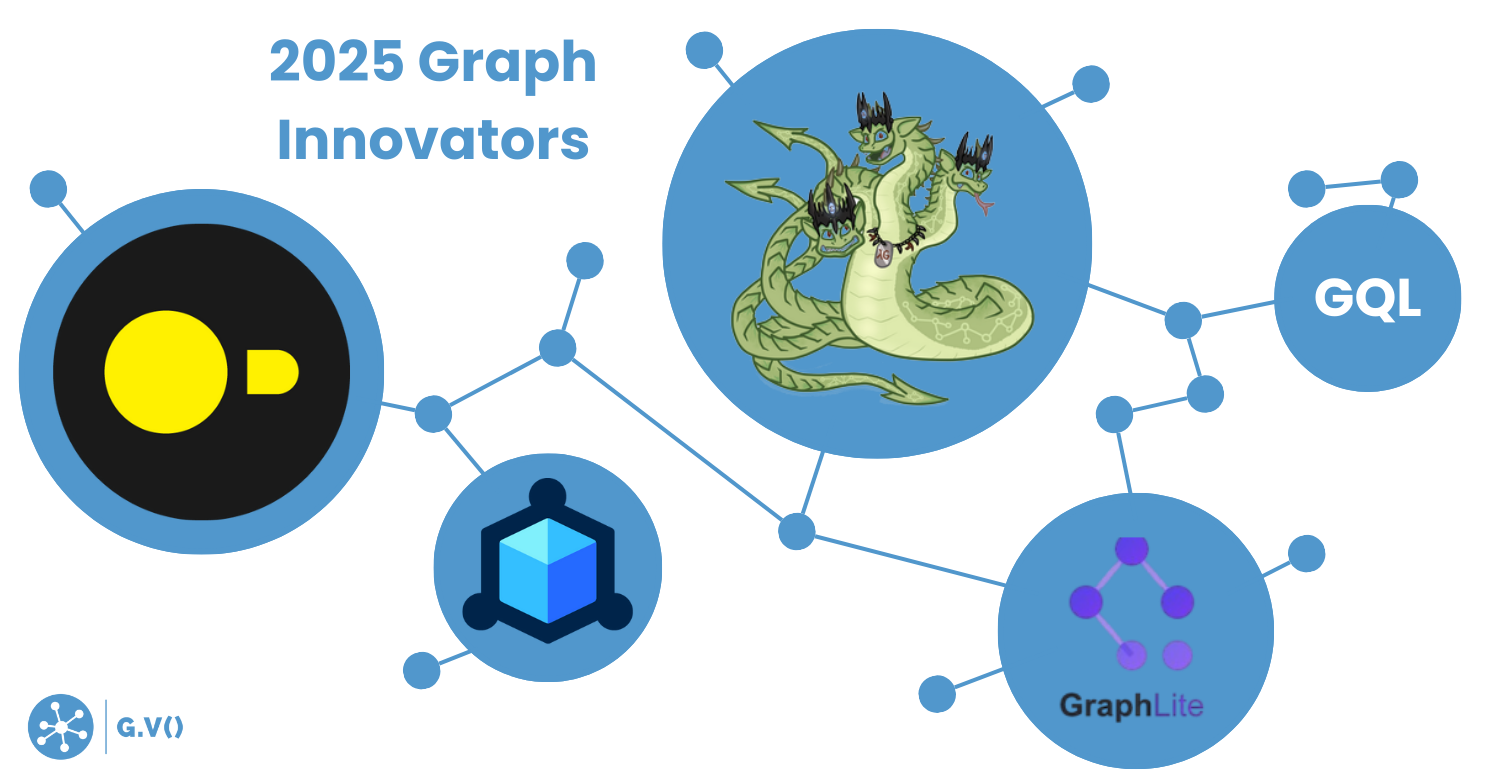
While big breakthroughs might have dominated the graph tech headlines in 2025, it’s worth giving some attention to the projects that demonstrated early graph innovation over the past year. We believe these items below are certain to make a big splash in 2026.
Hail Hydra
Hydra is an open source graph programming language based on the LambdaGraph data model that’s being developed by Josh Shinavier, a co-founder and long-time contributor to Apache TinkerPop™. Hydra was previously used in closed-source versions at both Microsoft and Uber, so this will be a language to pay attention to. My colleague Amber Lennox wrote up a great introduction to Hydra earlier this year, or watch this 2-part sneak-peek (Part 1 | Part 2) of Hydra in action.
DuckDB Goes Graph with DuckPGQ
You can now process graphs in DuckDB! This walkthrough on the DuckDB blog shows you how to use the DuckPGQ community extension to analyze financial data for fraudulent patterns with the SQL/PGQ graph syntax that’s part of SQL:2023. The DuckPGQ extension for graph workloads – developed by Daniël ten Wolde – is still a work in progress, but running graph queries on non-graph data is a helluva premise, so we’re keeping our eyes on this one. (Plus, that logo y’all! 😍)
GQL Keeps Growing
While not a sexy announcement, it’s notable that this year saw three graph projects fully implement ISO Graph Query Language (GQL): Google Spanner Graph, Ultipa Graph, and GraphLite (more below). Many other vendors are GQL-compliant (such as through GQL-compliant Cypher) but this quiet shift shows the slow work of standardization in progress. It will be interesting to see which other graph technology vendors join this club and go full GQL in 2026.
GraphLite
Embeddable graph databases were all the rage in 2025 (and likely in 2026 as well). Announced in late November, GraphLite, is an open source embedded graph database implementing ISO Graph Query Language (GQL) in Rust. Gajanan C., CTO of DeepGraph AI, shared that this choice to use GQL was intentional: “Just as SQL transformed relational databases, ISO GQL will do the same for graphs.”
Nodestream
Nodestream is a declarative framework for graph construction, management and analysis that’s fully compatible with both Neo4j and Amazon Neptune. Dive into an example in this blog post from the G.V() team, or check out the Neptune documentation for more details. Designed to be flexible and extensible, Nodestream helps graph newbies and novices to “think in graphs” without any prior training – further accelerating graph technology adoption in the year to come.
–
Whew, what a year! The Weekly Edge will be taking a two-week break for the holidays. We’ll be back at full, sunny strength on 9 January.
If you want to read all the graph technology news from 2025 as a week-by-week feed, check out the Weekly Edge archives and scroll a looooong way down. Or, if you’re more interested in the future than the past, subscribe to the Weekly Edge newsletter below and get the latest graph tech news in your inbox every Friday. ⚡

![Evaluating Codebase-Oriented RAG through Knowledge Graph Analysis [Part 2]](https://gdotv.com/wp-content/uploads/2026/03/knowledge-graph-analysis-codebase-oriented-rag-part-2.jpg "Evaluating Codebase-Oriented RAG through Knowledge Graph Analysis [Part 2]")