Semantics takes center stage at Connected Data London 2026

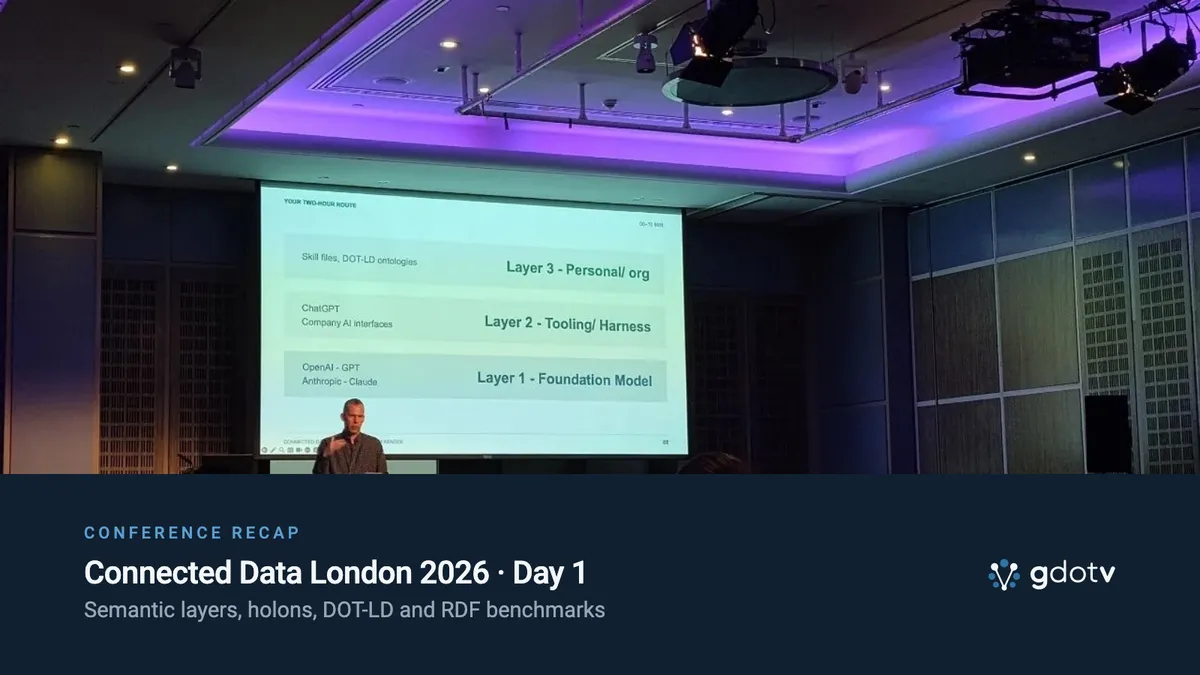
I attended the first day of Connected Data London 2026 on 11 November.
It was a real pleasure, and also a missed opportunity, because I had to leave London after the first day.
But even on the first day, I was fortunate enough to attend some very interesting talks and to connect with folks I had mostly met virtually. I learned a lot, and in this post I just want to share my experience, the notes I took away, and the trends and important caveats I noticed.
At Connected Data London, my initial goal was to attend as many ontology design, maintenance, and data governance sessions as possible, and, out of personal interest, to follow anything related to the Semantic Web.
First catch-up
I arrived around 9:10, which was already very close to the start of the first sessions. During registration, I met Arthur. Networking and the exhibition were still going on, so I took a look around, and within my first few steps I met Bryce Merkl Sasaki.
Bryce used to work for gdotv, and meeting him in person was a pleasure. We touched base on what we are currently doing at gdotv and what he is doing as the Executive Director of GraphGeeks.
Besides the personal catch-up, we also briefly discussed the role and current state of AI/LLM tools in ontology engineering. The fact is that today it is very easy for practitioners, and even amateurs, who know how to properly guide an agent to generate an ontology or a data model, and these agents/environments can also produce pleasant-looking artifacts for demos and presentations.
We talked about how, while those can be useful, their main limitation (currently) is that they are one-off use cases. When it comes to keeping track of things, or when a model needs to be worked on collaboratively (between team members, across multiple teams, between companies, or in public), these tools struggle to provide an experience that is both practical and smooth.
First talk session: Rapid Insights Track
For the first session, I attended the Rapid Insights Track. Interestingly, almost all five lightning talks were about semantics. Of course, the current trend around semantics is different from what I know as the Semantic Web (which is one of the ways a semantic layer can be applied on top of raw data from multiple sources).
That was clearly laid out in the professionally co-presented talk “Bridging Knowledge, Data, and AI” by Joseph Hilger and Benoit Gaussin (the talk shares its title with Enterprise Knowledge’s recent book on the semantic layer). In their talk, they carefully defined the core notions of the semantic layer and what they are doing with them at Enterprise Knowledge.
At the very base of all the upper layers, they placed the concept of knowledge assets as the combination of raw data and “people”. This is interesting because people in an ecosystem are sometimes forgotten as a knowledge asset that must be taken into account when designing the upper levels.
The importance of manifestation in conceptual content modeling was the subject of the next talk, “One Graph, Many Manifestations” by Marc Salvatierra and Cruce Saunders. Their starting point is that most content management systems only hold implementation schemas, so they keep a conceptual content model in RDF, outside any CMS, and treat the CMS as a projection of the graph, because, in their words, “the graph is where publishing should start.”
For me, the interesting part was that they mentioned and supported ShEx in their system. ShEx, or the Shape Expressions language, is a well-defined language for describing RDF graphs that serves a very similar purpose to SHACL, but with much stricter rules and definitions around recursion.
ShEx is used as the schema language of Wikidata (known as EntitySchemas) and also has several industrial biomedical applications, such as FHIR. It is being standardized under IEEE as P3330, and I have been a member of the working group. I am always happy to see ShEx appearing in graph projects and quality measurements.
The next talk, “Experience Feedback: Expanding from a Specific Knowledge Graph towards an Enterprise-Wide Initiative” by Gaëtan Belbéoc’h, started a bit later than scheduled, but I found it very interesting too. After more than seven years of running a large, product-focused knowledge graph for an e-commerce platform, his team at Adeo (a large European retailer with around 100,000 employees) was asked to extend it to the whole company to support an agentic AI strategy. Rather than trying to do everything at once, they built on their existing culture of continuous delivery, agile practices, and sociocracy, and worked in three parallel layers:
- Collecting and prioritizing seed subjects together with business teams.
- Building open-source tooling to make semantic modelers more efficient.
- Using inner-sourcing and sociocratic governance so that business users can create, improve, and connect small end-to-end knowledge graphs that answer their own questions.
Andreas Thalhammer also gave a more fundamental presentation, “One Entity, Many Systems: Building the Semantic Backbone for AI Co-Scientists”, on enhancing the quality of the entities in the knowledge graph they have at dsm-firmenich. In biochemical research, substances, organisms, inventory, and measurements are recorded across many different platforms, often with inconsistent names and identifiers and limited export options. Their answer is a knowledge graph layer that gives each research entity a consistent identifier and tracks its lineage across systems, with duplicate checks, reconciliation, cross-system lineage queries, and even QR codes to identify physical items. The plan is for this layer to become the semantic backbone for agentic AI “co-scientists”.
And finally, the last lightning talk of the first session was “MetaDot” by Cedric Berger, about the importance of context for LLMs, which is a common need these days. However, their approach focused on making that context specific to the computational requirements of each use case.
MetaDot is a context-engineering methodology that combines knowledge graphs and LLMs to build a separate semantic layer for each use case, with a meta-layer on top that semi-automatically builds those layers and learns across use cases. The argument is that AI in pharma and biotech needs explicit, computable business context to produce “decision-grade” output, and that this context has to be able to evolve without breaking the system. It has been tested across research, clinical operations, regulatory affairs, safety and pharmacovigilance, real-world evidence, and market access.
The lunch break & outreach
During the lunch break, I managed to meet Kurt Cagle in person. About a month earlier, we had discussed several aspects of ontology authoring in an online call, focusing on the importance of ontological metadata that can be inferred from SHACL shapes or other ontological objects.
In our in-person chat, we continued with the philosophy behind OWL and SHACL in ontology design. OWL, despite all its capabilities, has in practice fallen somewhat behind the needs of today’s world because of its relatively permissive approach to constraints.
I mentioned that, for example, around 2020 (back when I started my PhD on KG data quality), many ontology users were people who already had a graph and were trying to use different inference and reasoning techniques to expand what could be derived from the graph’s data, without adding new data, so that they could answer different kinds of questions.
But today, the range of ontology users has expanded considerably. Many of them don’t already have a graph. Instead, they’re trying to build one from a combination of different relational and non-relational data sources, or they’re trying to populate an initial graph. This means they have a much greater need for mappings and strict rules to ensure the quality of those mappings.
And surely, in these scenarios, SHACL’s constraint system is more directly useful than the world of logical definitions provided by OWL, and I believe Kurt agreed with this observation.
Second session: Ontologies Without Ontologists
In the second session, my plan was to attend Adam Rendek’s two-hour masterclass (co-listed with Lee Bowles), “Ontologies Without Ontologists: Shifting Semantics Left into Engineering Documentation”. The title is a bit deceiving, because the session actually proves the importance of ontologies in the process. The idea, however, is to develop languages that can embed semantic layers inside the engineering documents themselves.
The session started with the importance of using LLMs in engineering, and the problem that there are three layers of access between the company-specific semantics at the top and the core LLM model at the bottom.
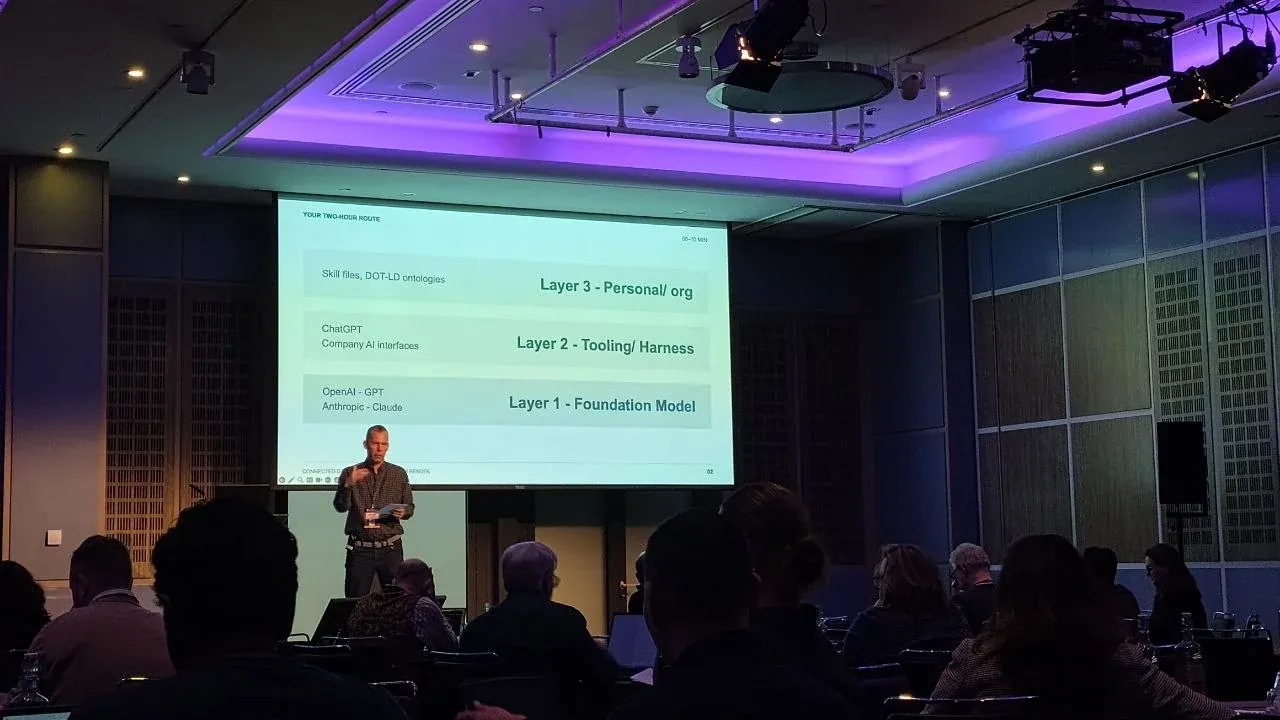
While most of us usually don’t have access to the core model, we also don’t have direct access to, or control over, the second layer, because of the guardrails, directives, and rules that control the input to and output of the models. So the third layer is where we have the most control, and that is where we should put the semantics to get the best outcome.
Adam also gave a definition of hallucination during the session: “when it is mathematically impossible to have an answer, but the model generates one!” The fact is that semantics embedded in the engineering documents that are fed to the model can make a huge difference to the quality of LLM outputs in a company-specific context.
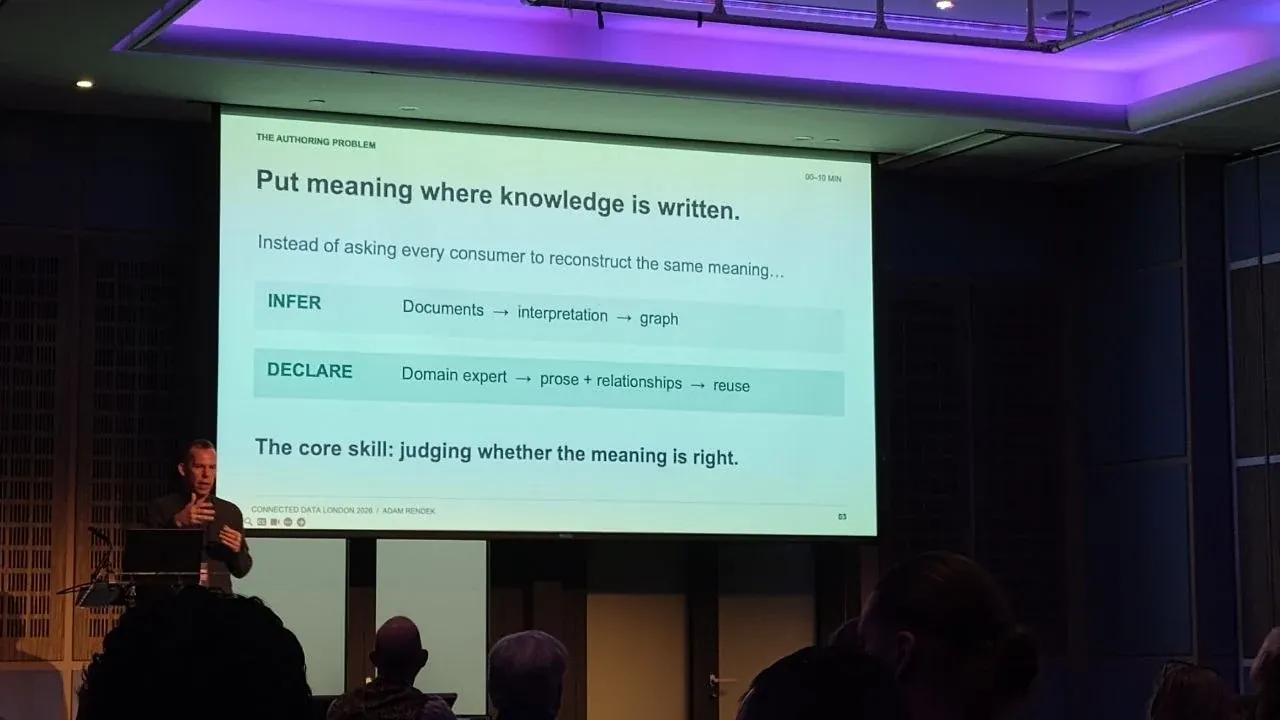
This is where Adam introduced DOT-LD, a lightweight Markdown extension he co-authored with Ora Lassila and Adesoji Adeshina, open-sourced under MIT-0.
To me, DOT-LD looks more like another graph serialization format, but with some interesting additions. While it doesn’t offer the full expressivity or capabilities of OWL or SHACL, it introduces some basic primitives for defining entities, types, and relationships directly within Markdown (::config blocks for types, [[EntityName]] references, and ::rel relationships).
I think this could be particularly useful for LLMs, making it easier for them to read, generate, and work with structured knowledge embedded in human-readable documents. So perhaps its real value is not in introducing a new knowledge representation model, but in providing a lightweight, LLM-friendly way of authoring and exchanging graph-structured information.
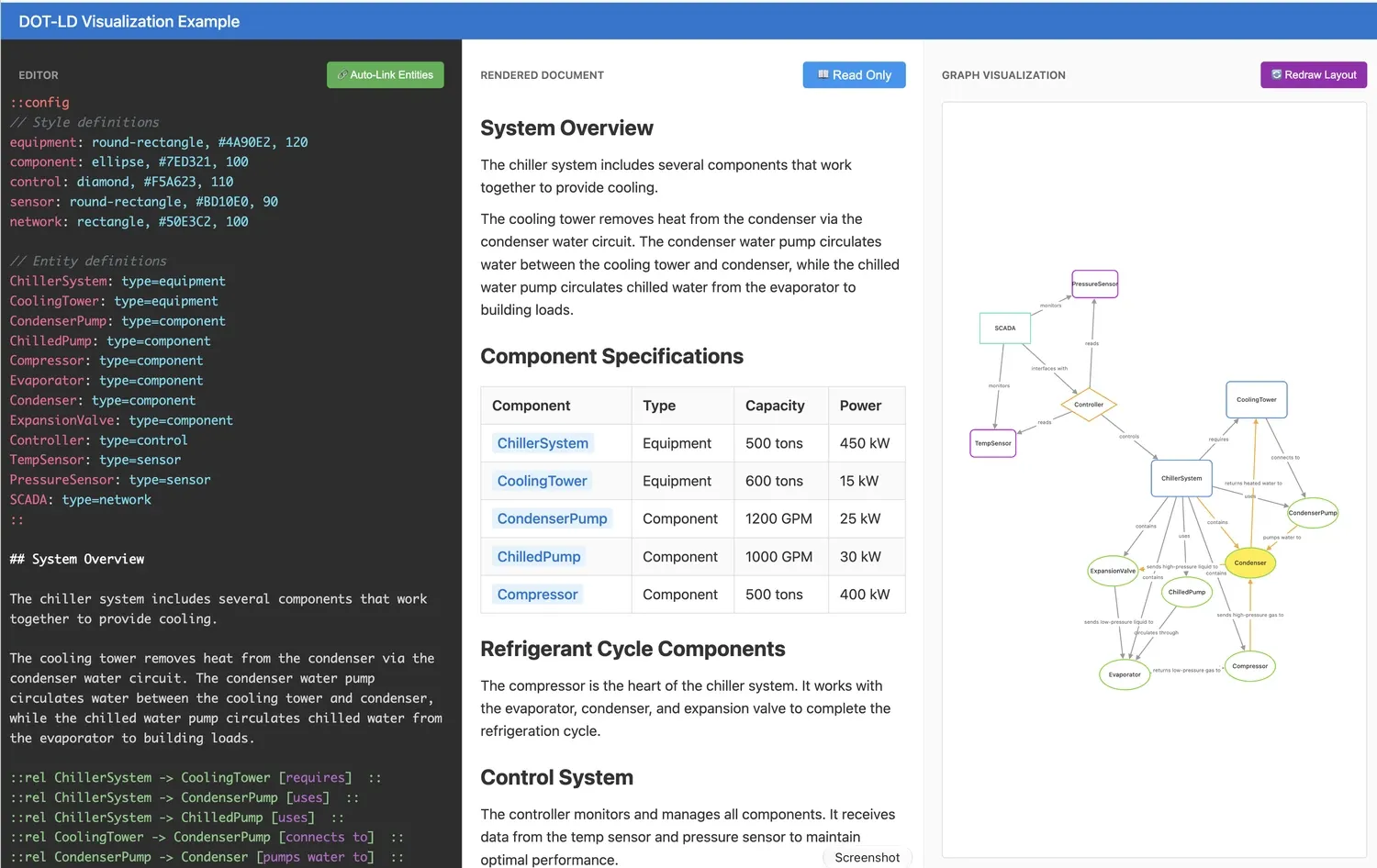
Adam also used a tutorial-like exercise to give the audience a chance to try the language, the visualization (with a VS Code extension), and its use with LLMs themselves, which made it an interactive experience!
Second catch-up
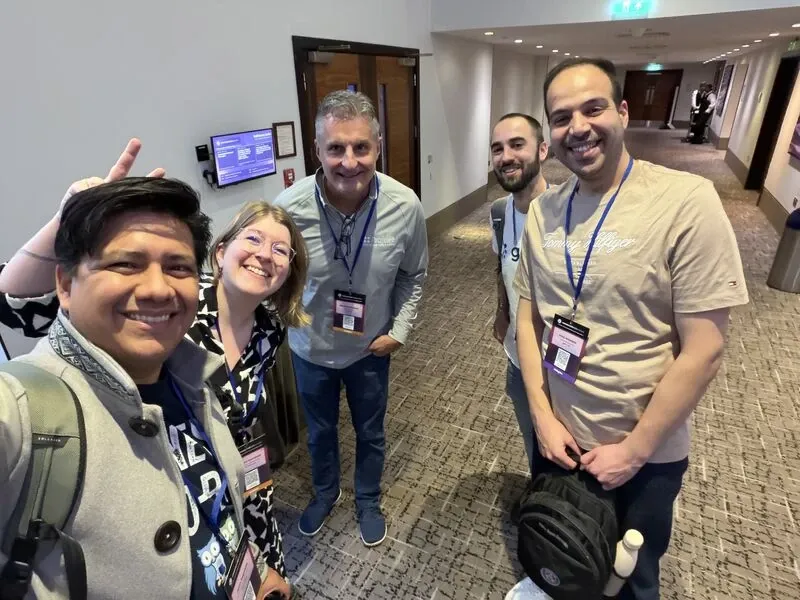
During the second networking and exhibition break, I managed to fulfill one of my long-time wishes: meeting and connecting with Juan Sequeda. It was a pleasure to see him and Veronika Heimsbakk together.
I also managed to demo what I am currently doing in data modeling and ontology authoring in gdotv, and I received important yet sharp feedback. The way highly experienced people like Juan see the paths ahead is always insightful for me, and it helps me look at what I am doing from a higher-level perspective, especially when, in the middle of a project, I might be too close to my own design to see the bigger picture.
Last session: Rapid Insights Track
In the last session, while working a bit on my own notes and handling LinkedIn connections, I managed to give my full focus to two of the lightning talks.
The first talk was given by Kurt Cagle about holons: “Towards Holonic Data: Holons, DataBooks, and the Boundary Problem in Distributed Graphs”. I had the chance earlier to see a demo of the editor he created for managing holons, but in this talk I figured out what holons actually are.
The term goes back to Arthur Koestler, who in 1967 described a holon as something that is a whole in itself and, at the same time, a part of a larger whole. Kurt’s argument is that knowledge graphs, and the LLM agents that query them, are missing a formal notion of a graph’s boundary, so agents end up either with no usable scope or with unrestricted access that lets them hallucinate beyond what they know. A holon gives a graph that boundary and an interface, using RDF 1.2 and SHACL 1.2 for validation, projection, and interface definitions, with DataBooks and the Model Context Protocol as the connection layer.
I have made a note to myself to join the W3C Holon Graph Community Group, which Kurt launched in June 2026 to formalize this work in the open.
The second talk was given by Veronika: “Mind the Gap: 11 RDF Frameworks, Honestly Benchmarked”, which was about benchmarking (or “trainmarking”, as Veronika herself put it!) 11 RDF frameworks and triple stores using randomly generated, relatively large RDF data. With some cold runs and some warm runs, we saw how differently the frameworks behaved in loading, normal queries, aggregation queries, and update queries.
Considering that I have worked quite a bit on benchmarking with randomly generated graphs, and on the limitations and false-positive or false-negative results those randomly generated files can produce, this benchmark was very insightful. I’m not gonna reveal the results, so you can examine the benchmark yourself on your own laptop!
Final hour
Unfortunately, as I mentioned, I had to head off to Edinburgh at the end of the first day, but the day was very fruitful for me. In the final hour, while I was stressing about catching my flight from Stansted Airport (and god knows I arrived as the last passenger to board, a second before the gate closed!), I managed to do a five-minute interview with my friend Bryce about what I learned at Connected Data London 2026 and the past and future of the Semantic Web.
As I said to him, even though RDF is simple by nature, its philosophy, its applications, and its hidden aspects are still being investigated, and will and should be investigated further, to meet all the semantic requirements I witnessed during this conference.
If you want to see your SHACL shapes and OWL ontology as one explorable data model, give gdotv a try on your own RDF graph.
About the author

Dr. Seyed Amir Hosseini Beghaeiraveri
Data Scientist
Amir holds a PhD in Computer Science from Heriot-Watt University and recently completed his postdoctoral fellowship in Large-Scale Nested Data Processing at the University of Edinburgh's School of Informatics. He brings several years of experience in graph-based structures and semantic web technologies to the team, with a focus on data processing and validation. As a long-time RDF user, he leads the continuous design and implementation of solutions for RDF/SPARQL users at gdotv.