Graph Chat with Arun Sharma, Founder of LadybugDB

Long ago, there was Kuzu, the embedded graph database, the DuckDB of graph technology. With it, the graph world lived together in harmony.
Then everything changed when the [mysterious entity who acqui-hired the Kuzu team away from the project] attacked. When the world needed it most, Kuzu vanished.
It feels like 100 years have passed since 10 October 2025 when Kuzu was archived on GitHub, and the graph community is still searching for the Kuzu reincarnation that will rise to restore the honor of embedded graph databases.
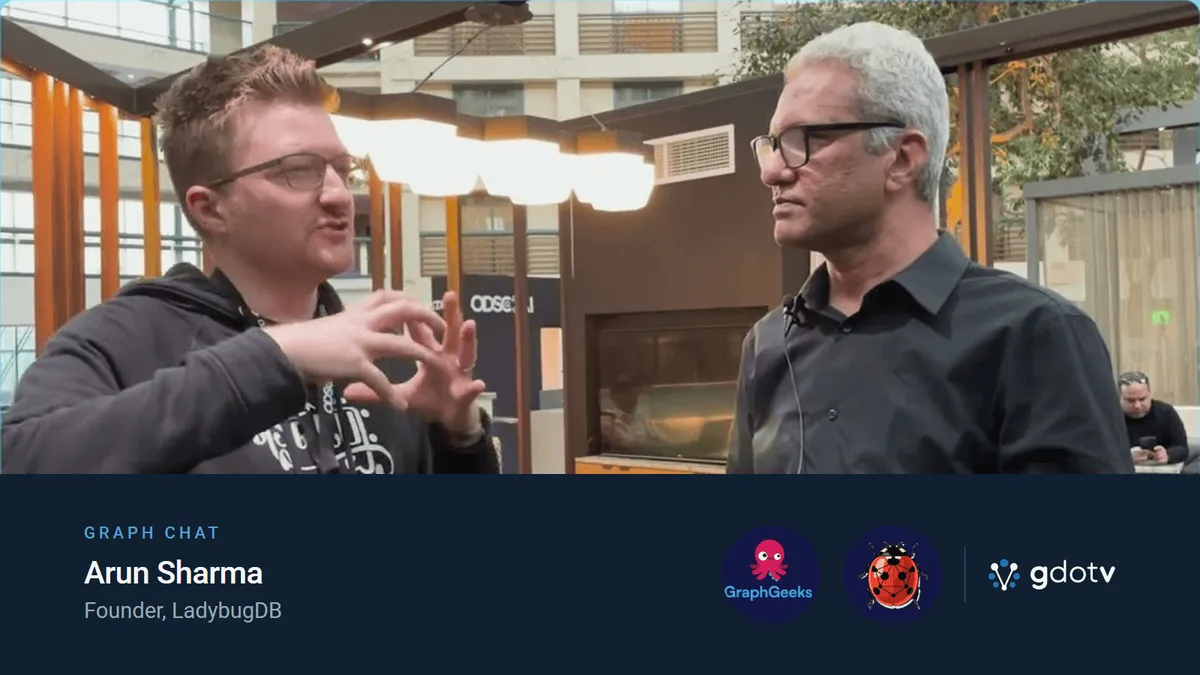
Fortunately, there are a number of Kuzu forks worthy of such a role. I believe one such project is LadybugDB. As part of a video series for GraphGeeks, I captured an interview with Arun Sharma, the Founder of LadybugDB, last autumn at ODSC West in San Francisco. Check it out below!
Graph Chat Interview with Arun Sharma
Arun Sharma is a former Senior Engineer at Facebook, where he developed the Dragon distributed graph query system. Today, he’s the Founder of LadybugDB, an open source, transparently governed fork of Kuzu DB.
In this Graph Chat interview, Arun shares his ambitious technical vision for the project:
- Graph Data Lake: LadybugDB aims to become the basis for a graph-specialized data lake, serving as the “Snowflake for graphs.”
- No Ingest: The LadybugDB community plans to eliminate the costly and time-consuming data ingestion (ETL) process.
- Standards & Scalability: LadybugDB is contributing to new interchange formats, adjacent to the Apache project Graph Archive, to make online, no-copy graph processing possible at scale.
Arun also shares his insights on the shift in the graph space toward columnar analytics and the rise of GraphRAG in AI/LLM applications.
More about LadybugDB
LadybugDB is an embedded graph database built for query speed and scalability. It is optimized for handling complex analytical workloads on very large databases and provides a set of retrieval features, such as a full-text search and vector indices.
Its core feature set includes:
- Flexible property graph data model and Cypher query language
- Embeddable, serverless integration into applications
- Native full-text search and vector index
- Columnar disk-based storage
- Columnar sparse row-based (CSR) adjacency list/join indices
- Vectorized and factorized query processor
- Novel and very fast join algorithms
- Multi-core query parallelism
- Serializable ACID transactions
- Wasm (WebAssembly) bindings for fast, secure execution in the browser
Ladybug is being developed by LadybugDB Developers and is available under a permissive license. So try it out and help us make it better! We welcome your feedback and feature requests.
Subscribe for More Graph Chats
The Graph Chat video series by GraphGeeks aims to ask diverse leaders and practitioners in the space about where the future of graph technology is headed. This and other episodes were sponsored by gdotv – the graph database IDE. Special thanks to Amy Hodler (GraphGeeks Chancellor, Studio Exec, Producer), David Hughes (Camera Wizard, Director of Photography), and to Denise Gosnell (Audio Engineer).
If you enjoyed this Graph Chat interview with Arun Sharma, subscribe to the GraphGeeks YouTube channel for more great discussions with leaders across the graph technology space.
About the author

Bryce Merkl Sasaki
Former Head of Marketing
Bryce Merkl Sasaki is a writer and editor based in Silicon Valley. A digital nomad and total nerd, he’s wandered the worlds of database and graph tech for more than a decade, covering big moments, interviewing interesting minds, and bringing abstract graph concepts back down to earth. Outside of work, he enjoys hikes with his wife in Northern California and writes on his science fiction novel.