Tag
Memgraph
Explore Memgraph setup guides, tutorials and news from the gdotv team. Discover how gdotv integrates with it to query, visualize and share your graph.
17 posts
The Weekly Edge: Zero ETL Federated GQL, Context Graphs Beyond the Hype, Graph AI Memory & More
Discover what’s new in graph tech this week, including a new graph query engine for federated GQL, a context graph talk, .NET dev for AWS Neptune and more.
The Weekly Edge: Graph DB Rankings, openCypher Compliance, the Ultimate Pokémon Graph, & More
Discover what’s new in graph tech this week, including a new site comparing 94+ graph databases, an openCypher tool, and the graph centrality of Pikachu ⚡
Evaluating Codebase-Oriented RAG through Knowledge Graph Analysis [Part 2]
Crack open your codebase RAG with a knowledge graph analysis that illustrates hidden dependencies and other structural breakdowns in part 2 of this series.
Cypher SET: Updating Node Properties in Your Graph Database [Byte-Sized Cypher Series]
Catch this video in the Byte-Sized Cypher series by Jason Koo teaching you how to use the SET clause in the Cypher query language to update node properties.
Evaluating Codebase-Oriented RAG through Knowledge Graph Analysis [Part 1]
We turn Soufflé’s codebase into a knowledge graph with Code-Graph-RAG and Memgraph, then trace inheritance chains and hub modules in gdotv to test its answers.
Cypher DISTINCT: Removing Duplicates from Results [Byte-Sized Cypher Series]
Catch this episode of the Byte-Sized Cypher series by Jason Koo teaching you all about how to use the RETURN DISTINCT clause in the Cypher query language.
The Weekly Edge: HugeGraph Goes Big, 2 Graph Releases, a Ticking Time Bomb & More
Discover what’s new in graph technology this week, including two graph database releases, a new OWL 2 RL reasoner, an annotated semantic layer video, and more.
Cypher MATCH Clause: Finding Nodes & Relationships in Your Graph [Byte-Sized Cypher Series]
Catch this episode of the Byte-Sized Cypher series by Jason Koo teaching you all about the MATCH clause in the Cypher query language and how to use it.
Cypher Labels: How to Organize Graph Nodes [Byte-Sized Cypher Series]
Catch this episode of the Byte-Sized Cypher video series by Jason Koo teaching you all about labels in the Cypher query language and when/how to use them.
Cypher CREATE Clause: Adding Nodes & Relationships to Your Graph [Byte-Sized Cypher Series]
Catch the first episode of the Byte-Sized Cypher video series by Jason Koo teaching beginners all about the Cypher query language and graph databases.
One Graph Client to Rule them All? [Video]
Watch this developer walkthrough video by Jason Koo and learn more about the gdotv graph database client and IDE that works with many graph technologies.
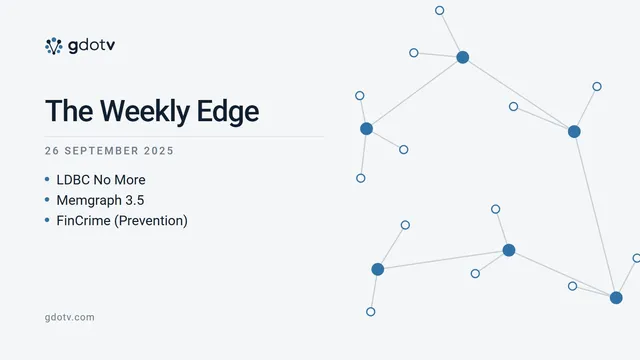
The Weekly Edge: LDBC No More, Memgraph 3.5, FinCrime (Prevention), & More [25 September 2025]
Discover what’s new in the world of graph technology this week, including the end of the LDBC (as we know it), a new graph approach to smart buildings, and more.
Our solutions
Whether you're an individual or part of a larger team, there's a version of gdotv that's right for you.
gdotv Desktop
The ultimate graph database IDE.
Install and connect your first graph database in 2 minutes.
gdotv Team
The unified workbench for graph data teams.
Deploy to your team in under 15 minutes. Marketplace or self-hosted.
gdotv Enterprise
The universal graph intelligence platform.
For organization-wide deployments. Bring graph data directly to your analysts.