
GraphDB IDE
& Graph Visualization Tool
Explore, query and visualize your graph data in GraphDB with gdotv.
A Purpose-Built IDE for GraphDB Developers
Graph DB is widely used in industries such as publishing, life sciences, and cultural heritage, where rich ontological modeling and Linked Data practices are central to data strategy.
Pairing GraphDB with gdotv provides a more flexible and purpose-built environment for visual graph exploration. You can craft targeted SPARQL queries in gdotv to extract specific subgraphs or relationship clusters, making it easier to communicate insights from large and intricate RDF datasets.
For organizations in publishing, life sciences, or any domain where semantic modeling is central, the GraphDB and gdotv combination offers a powerful route from structured ontological data to meaningful visual output.
 GraphDB
Graphwise (formerly Ontotext)
Query languages supported by gdotv: SPARQL
Learn more about GraphDB
An Overview of GraphDB
GraphDB, developed by Graphwise (formerly Ontotext), is a highly scalable RDF triplestore and SPARQL server designed for enterprise semantic data management. It is widely used in industries such as publishing, life sciences, and cultural heritage, where rich ontological modeling and Linked Data practices are central to data strategy.
GraphDB is fully compliant with SPARQL 1.1 and supports a range of OWL and RDFS reasoning profiles, allowing it to infer new knowledge from existing data based on defined ontologies at scale.
GraphDB boasts dedicated community support, integration with search applications like Elasticsearch, OpenSearch, Lucene, and Solr, support for clusters and multi-region deployments, search connectors, support for all RDF serialization formats, cloud deployment availability and more.
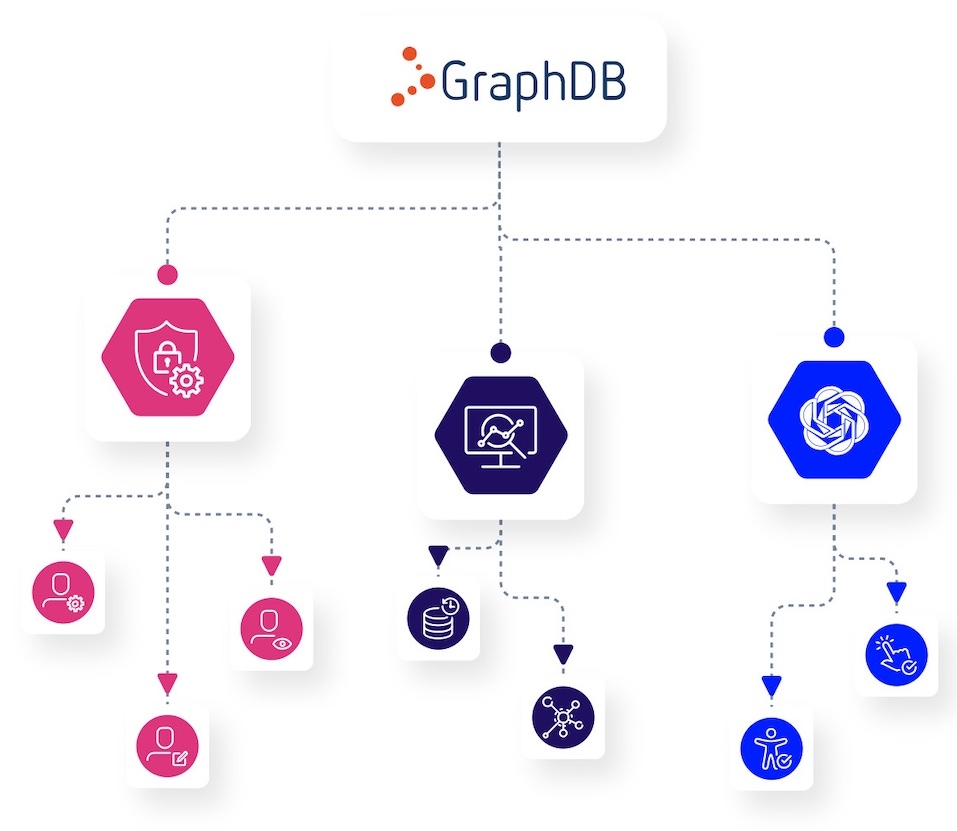
GraphDB is one of the most scalable OWL repositories available according to the LDBC Semantic Publishing Benchmark and is available via both free and enterprise editions.
What’s Possible with GraphDB + gdotv
Easy Installation & Setup
Effortlessly integrate gdotv with your GraphDB graph database with a simplified plug-and-play database connector. The gdotv database client provides straightforward database connection and configuration instructions to get you started in less than a minute.
This GraphDB IDE is available to download for Windows, macOS, and Linux with a one-click installer to get you started instantly.


Centralized Connection Management
gdotv can be used to query and compare data from a huge range of graph database vendors – simultaneously! We don’t just work with GraphDB: gdotv data visualization tools fully integrate with various other graph technologies, including all Apache TinkerPop™ compatible graph databases and most LPG and RDF providers.
gdotv is fully compatible with query languages like SPARQL, Gremlin, Cypher, Google SQL, SQL:2023, and more. Using an intuitive UI, you can switch between your connections and queries seamlessly.
Customizable Data Visualization
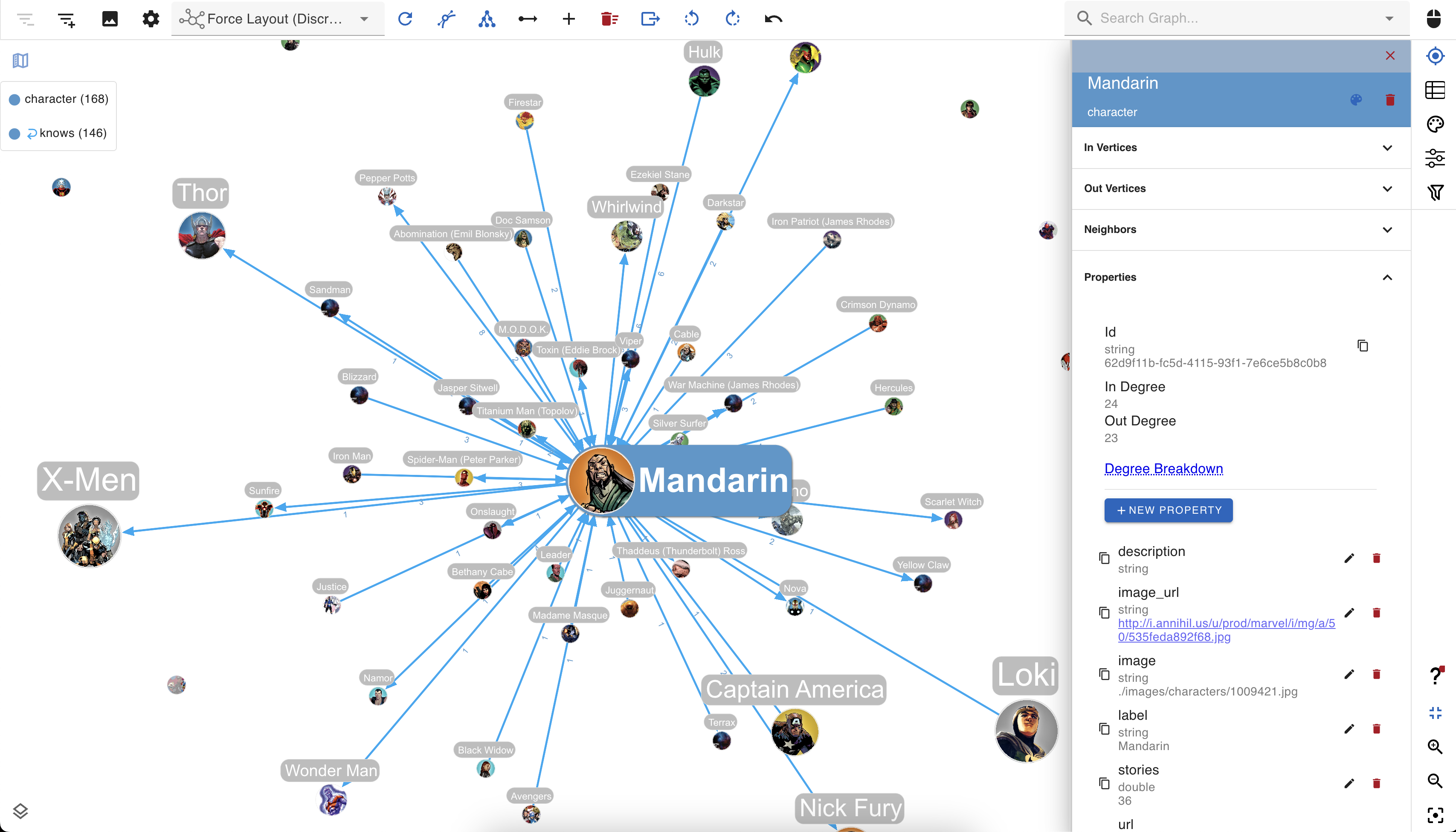
You can create custom visualization rules for your GraphDB graph database with gdotv to determine the look and feel of your data.
The gdotv database client boasts easy-to-configure style options that you can use to customize vertices and edges based on their labels and property values.
You can choose any color, size, or background image and adjust other elements to match your preference.
No-Code Data Exploration with the gdotv Graph Data Explorer

Use the built-in gdotv Graph Data Explorer to navigate your GraphDB data without using queries.
The Graph Data Explorer allows you to define path patterns to query from your data, using filters on both your vertices and edges. Elements in the declared path can be filtering according to their label, direction, and property values, allowing you to perform complex path-pattern searches with no code.
Instantly Load & View Your Data Model
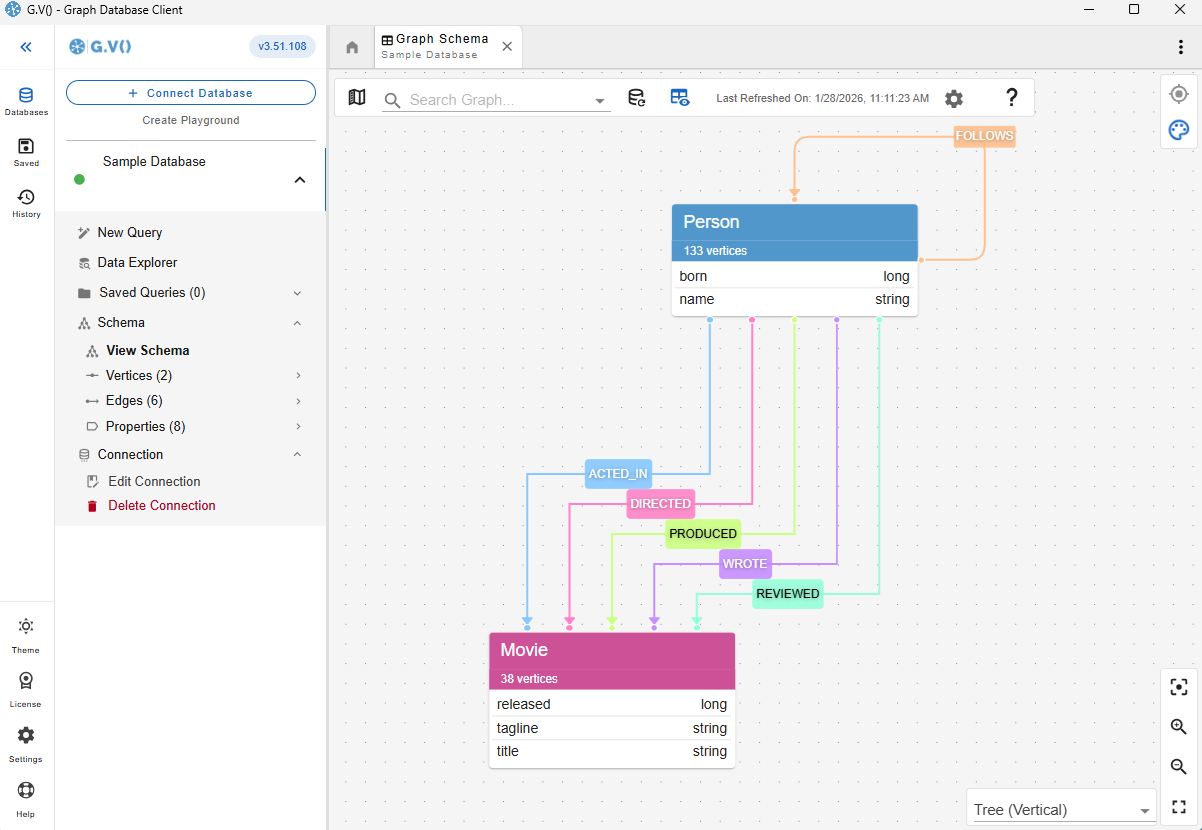
Understanding and verifying your data schema is critical component of graph management. This is why gdotv provides an overview of your data structure with the data model view.
For GraphDB, there is no need to provide a data model, as gdotv is able to infer the schema directly from the data itself. This is always just a click away, meaning that you always have an bird’s-eye view of your vertices, edges, and properties right at your fingertips.

Modify Your GraphDB Graph Data Directly within gdotv
Want to adjust something in your graph? Take a hands-on approach and manage your GraphDB graph directly.
Using gdotv, you can directly create, modify, and delete the edges and vertices – as well as modify the properties associated with them – allowing you to make changes on the fly.
Take Advantage of Syntax Validation
Using gdotv language highlighting and syntax checking for SPARQL makes your code easier to understand and visually parse, warning you of any error that would prevent it from executing against your GraphDB instance.


Take Control of your Queries with the gdotv SPARQL Query Guardrails
Since RDF is fundamentally schema-optional, gdotv won’t enforce any schema against your graph. It will, however, check your queries against the inferred schema, meaning it will automatically generate warnings if it detects potential ontology clashes.
This gives you additional insight into malformed queries, even when they execute normally against your RDF triplestore.
Visualization Optimized for RDF

gdotv offers graph visualization specially developed for RDF triplestores like GraphDB.
The nodes and edges are detected from your query results, and any literals will be interpreted as properties. To improve readability, gdotv has built in IRI shortening and prefix handling.
You can customize your graph labels further using inferred schema from the graph, such as via RDFS statements.

State-of-the-Art SPARQL Editor
The gdotv SPARQL code editor is the most powerful available – it offers data schema-accurate auto completion and embedded official documentation for SPARQL to give you all the information and suggestions you need to write your GraphDB queries faster and more effectively.
![The Weekly Edge: 2 Graph DB Releases, an Apache AGE Manager, Graph Versioning, & More [12 December 2025]](https://gdotv.com/wp-content/uploads/2025/12/graphdb-apache-age-graph-versioining-weekly-edge-12-december-2025-1024x535.png "The Weekly Edge: 2 Graph DB Releases, an Apache AGE Manager, Graph Versioning, & More [12 December 2025]")
Frequently Asked Questions (FAQs)
gdotv: The GraphDB IDE
Turn your graph data into connected insights when you use gdotv to query, explore, and visualize your GraphDB graph database.
Sign up for a free trial today and discover how gdotv amps up your productivity as the perfect GraphDB IDE and graph visualization tool.
Or, prefer to talk with the gdotv team directly? Use the form below to get in touch.