The Weekly Edge: Neo4j Virtual Graphs, Graphing Snowflake, LegalGraphRAG & more

We’re here with another curated week of news, hand-picked by the gdotv team. There’s a common thread this week, which is the influx of developments of graph-on-relational technology. We’re increasingly seeing a rising demand for routes to deploy graph analytics against traditional database vendors. We suspect the rise of interest in GraphRAG is a major driver of this transition.
Of course, we hardly think Weekly Edge readers need to be convinced of the value of graphs, but it’s exciting to see the industry coming around to our point of view.
This week we’ll cover:
- No- fuss Neo4j: Neo4j Virtual Graph, an alternative to Neo4j-hosted graphs that offers a zero-copy way to access your relational data store.
- AGE of Snowflake: A Snowflake blog post detailing how you can use Apache AGE against any Postgres engine. (Did you know that means you can run graphs against Snowflake?)
- Order in the court! LegalGraphRAG, a proof-of-concept exploration of how on Earth you might actually deploy GraphRAG against the complex world of legal documentation.
- New me, new bug: A new version of LadybugDB with all kinds of exciting features, including a file format that greatly simplifies database versioning.
- Postgres progress: The emergence of an enigmatic new graph framework for Postgres – pgGraph. It’s too early to say where this project will lead, but if you’re looking for a graph-on-Postgres alternative to Apache AGE that uses GQL instead, it may be worth a few minutes of your time to check it out.
If you’re new here, the Weekly Edge is your weekly tl;dr of graph technology news curated by the team at gdotv, giving you all the reads, repos, vids, and walkthroughs worth exploring from the past seven-ish days (or so).
Let’s take a closer look.
[News:] Neo4j Introduces Virtual Graphs
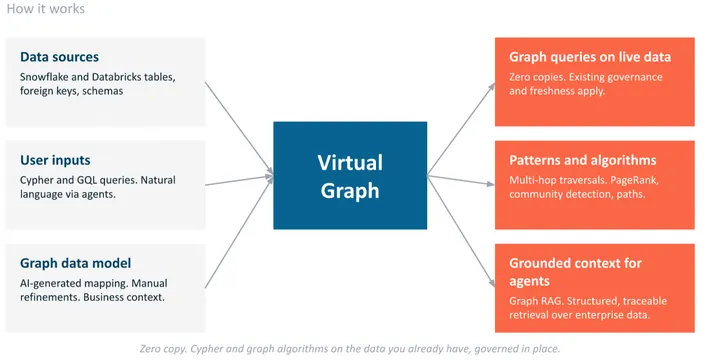
Neo4j has introduced a new service, Neo4j Virtual Graph, available in private preview. The idea is simple: graph-on-relational application without any duplication of data. That means that you now can obtain graph insights on your Snowflake, Databricks, or other database store, without the need to implement any new controls or system records. This brings instantaneous Cypher querying and pathfinding on the data you already have
By default, the built-in LLM proposes a basic model for your graph, which you can then review and adjust by hand. Cypher queries themselves are parsed through deterministic SQL commands under the hood, without LLM interference, ensuring your results are consistent and predictable.
Virtual Graph is positioned as an alternative to a Neo4j-stored graph for situations where duplication, migration or parallelization of existing relational databases and processes is undesirable. For these contexts, Neo4j Virtual Graph offers an unobtrusive route to graph-based insights. For maximum efficiency and functionality, however, Neo4j still recommends its own natively stored graph environment. You can learn more about gdotv’s own support for Neo4j here.
[Release:] Apache AGE is out on Snowflake

Our next update offers more exciting graph-on-relational insight from a recent blog post published by Elizabeth Christensen. This post details how Snowflake Postgres can be used with Apache AGE to leverage graph-based insights against your relational data store.
The discussion itself isn’t Snowflake-specific. Anything running on a Postgres engine can be attached to Apache AGE’s open-source framework, which is a powerful route to accessible graph analytics. Christensen assumes a non-graph audience, walking the reader through the basics of graph construction, demonstrating how Cypher can greatly simplify length and contrived SQL queries.
If you’re reading the Weekly Edge, much of this will be familiar to you already, but we included this blog post because you might not be aware that you can use Apache AGE against your Snowflake database in this way! Excitingly for us, that also means that you can use gdotv with Snowflake, by connecting gdotv to your Apache AGE instance. It’s always exciting to see more vendors adopting graph-based functionality, and gdotv is already exploring further ways to integrate with Snowflake.
[Long Read:] LegalGraphRAG
When it comes to discussing the theory of knowledge graphs and GraphRAG, it’s easy to get stuck on the abstract notion of data. This next update grounds us firmly in the real world, with a well-defined context: legal reasoning.
Legal documents contain all kinds of information, such as descriptive accounts, formal definitions of policy, and discussions of abstract principles. This heterogeneous environment creates a corpus that is intuitively navigated by human reasoning and rhetoric, but often highly opaque to LLMs without those tools, at least without a lot of help.
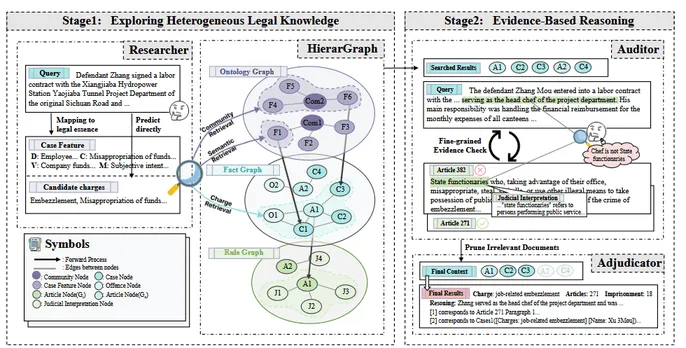
In an attempt to tackle this messy problem, Chen et al. have introduced LegalGraphRAG, a framework that trials separating the problem into two phases. In the first phase three specialized graphs are constructed (a “Fact Graph,” an “Ontology Graph” and a “Rule Graph”), against which GraphRAG is run in the second phase. The authors acknowledge some limitations of the pipeline, like that it can only accept text-based inputs, but it illustrates one potential methodology for how one might approach this problem.
[ICYMI:] pgGraph Brings Highly-Optimized Graph Workloads to Postgres

Since we mentioned Postgres earlier, another interesting development is the arrival of pgGraph, an extension designed to run basic graph algorithms and traversals against Postgres tables.
The project is Rust-based, built by Evokoa, and still in the alpha stage of testing. It promises to serve as a zero-copy graph layer for graphRAG and LLM reasoning, all within an accessible architecture. It is showing promising results especially compared to alternatives like Apache AGE, thanks to graph-native style optimizations (e.g. CSR edge stores) so it is one to watch. They’ve also just recently released GQL support!
[Release:] LadybugDB v0.17.0 Release

Just last week the gdotv team released our retrospective on the late and much-loved Kuzu. In that blog post, we pegged LadybugDB as the leading candidate to take up the mantle moving forward.
So it’s exciting news that LadybugDB v.0.17.0 is out now! This introduces a lot of new features. One of the most exciting, in my opinion, is that storage upgrades are now handled in place via the introduction of Icebug Format v1. This means no more unnecessary friction of exporting and importing data to update the file format between LadybugDB versions. So there’s even more reason to be excited for future updates.
The new version also brings a host of other updates, such as improving SQL integration, support for Arrow Database Connectivity, leaner indexing and a host of others. If you’re a gdotv fan who’d like to get started with LadybugDB, check out our overview of LadybugDB.
P.S. Looking for more graph-on-relational discussion? Check out Arthur’s recent review of the graph-on-relational landscape. For more hands-on applications, check out gdotv’s recent blog posts on calling S3 data into your Neptune cluster, or constructing a product recommendation system with BigQuery Graph.
P.P.S. If you are just desperate to know more about Apache AGE, gdotv has also published a real deep dive (four parts!) on Apache AGE. Check out part one here.
P.P.S. Got an item to nominate for the next edition of the Weekly Edge? Hit us up at weeklyedge@gdotv.com.
About the author

Dr. Amber Lennox
Developer Relations Engineer
Amber manages developer relations at gdotv and (when not deep-diving into documentation) can be found wild swimming in questionable weather and working on personal programming projects like developing software for language learning. With a PhD in Astrophysics, Amber is particularly drawn to the mathematical and scientific aspects of graph theory and analytics.