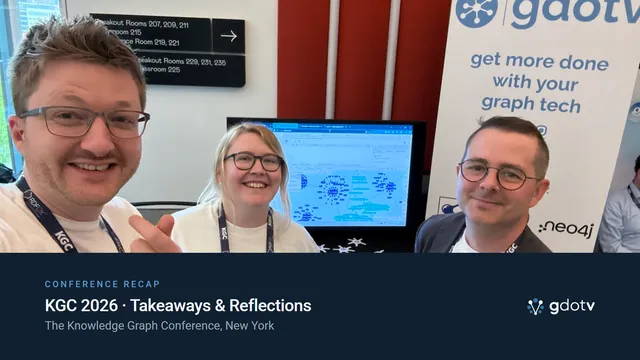
We’ll See You at the Knowledge Graph Conference 2026!

If you know anything about knowledge graphs – or know anyone connected to the field – then you’ve certainly heard of the Knowledge Graph Conference.
It’s like the World Cup and the Super Bowl and Eurovision combined, but if everyone was hyped up for networks of connected data for storing and extracting information. It’s sort of a big deal. 😏
Now in its 8th edition, the Knowledge Graph Conference (KGC) happens on May 4th-8th, 2026 on the campus of Cornell Tech in New York City. If you haven’t already, get your tickets to KGC here!
This year, gdotv returns as a bronze sponsor of KGC, and whether you’re a first-time attendee or a seasoned KGC vet, we’re looking forward to meeting you there! We’ll also be leading a workshop at KGC, so before anything else, here are the details:
Workshop: How to Build Your First Knowledge Graph Using Hydra, for RDF and LPGs
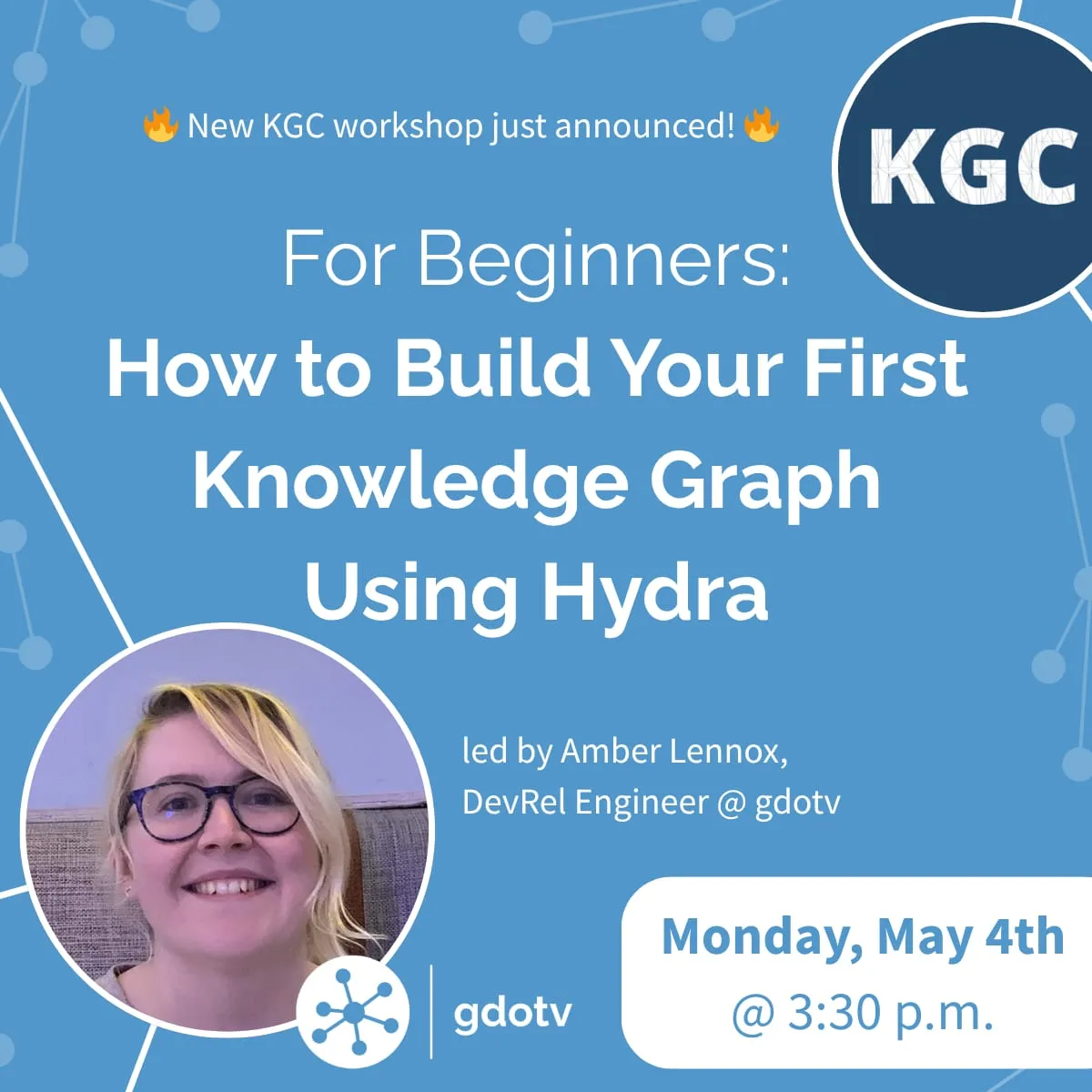
If you’re new to the world of knowledge graphs, this workshop is for you: Knowledge graphs offer your team endless opportunities, so it’s time to learn how you and your team can build your own for the (very) first time.
In this workshop designed for beginners, DevRel Engineer Amber Lennox from gdotv shows you how to get started with building your own knowledge graph for either RDF triplestores or LPG graph databases using the open source Hydra graph programming language (created by Joshua Shinavier).
This workshop assumes no previous background with knowledge graphs, RDF triplestores, SPARQL, or other graph technologies. You’ll leave the workshop with a prototype working knowledge graph that you can take back to populate with your own data and use as a basis for further enterprise applications.
Session info: Monday, May 4th 3:30 p.m. in Classroom 225
Already attending KGC? Add the workshop to your agenda in the Whova app! 📅
Still need to nab your virtual ticket? Get it here
Okay, self-promo over. Curious to learn more about this year’s event – including which sessions I suggest you can’t possibly miss? Read on!
About the Knowledge Graph Conference
The Knowledge Graph Conference (KGC) has been bringing together the world’s knowledge graph experts for 8 years. Designed as a meeting point between academia and industry, KGC was co-founded by François Scharffe and Thomas Deely with the first edition of the event being held in New York in 2019.
Today, KGC gathers together experts across the fields of information architecture, graph databases, AI, ontologies, graph neural networks (GNNs), taxonomies, RDF triplestores, graph data science, the Semantic Web, large language models (LLMs), graph visualization, and more. The common thread tying it all together is how to use these connected data technologies to organize, store, and extract knowledge.
While every conference tries to position themselves as the event within the industry, the fact is, KGC really draws in the experts every year. Just check out the KGC agenda here to see who’s presenting, or here’s a sample of all the industry experts and practitioners I got to interview* for the KGC YouTube channel last year:
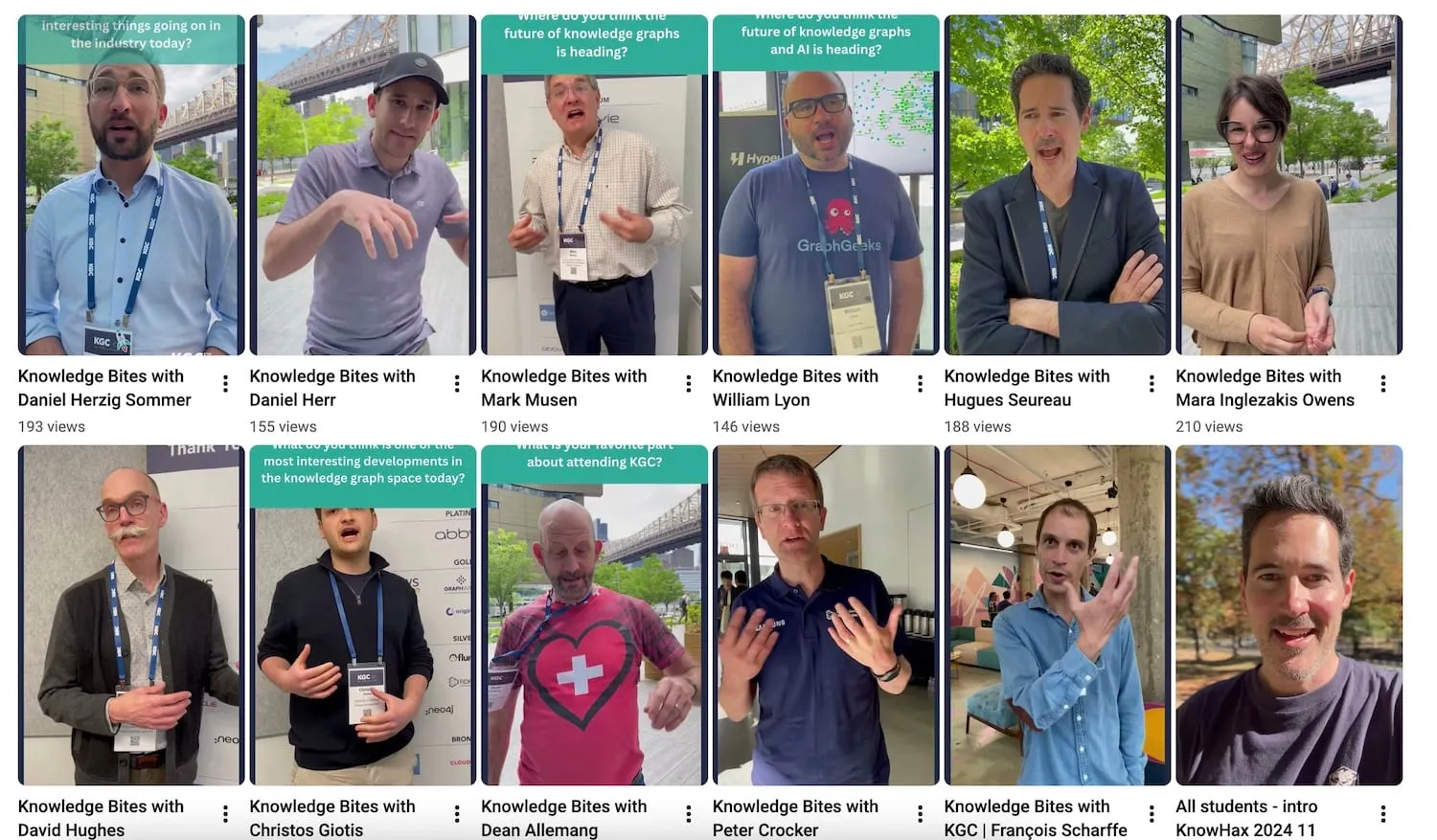
If you want a better set of graph technology experts or a better set of conference testimonials, I don’t know if you’ll find them anywhere!
*(Full disclosure: I used to work for KGC in 2025, but this year I’m only returning as a sponsor.)
Meet the gdotv Team at the Knowledge Graph Conference 2026!
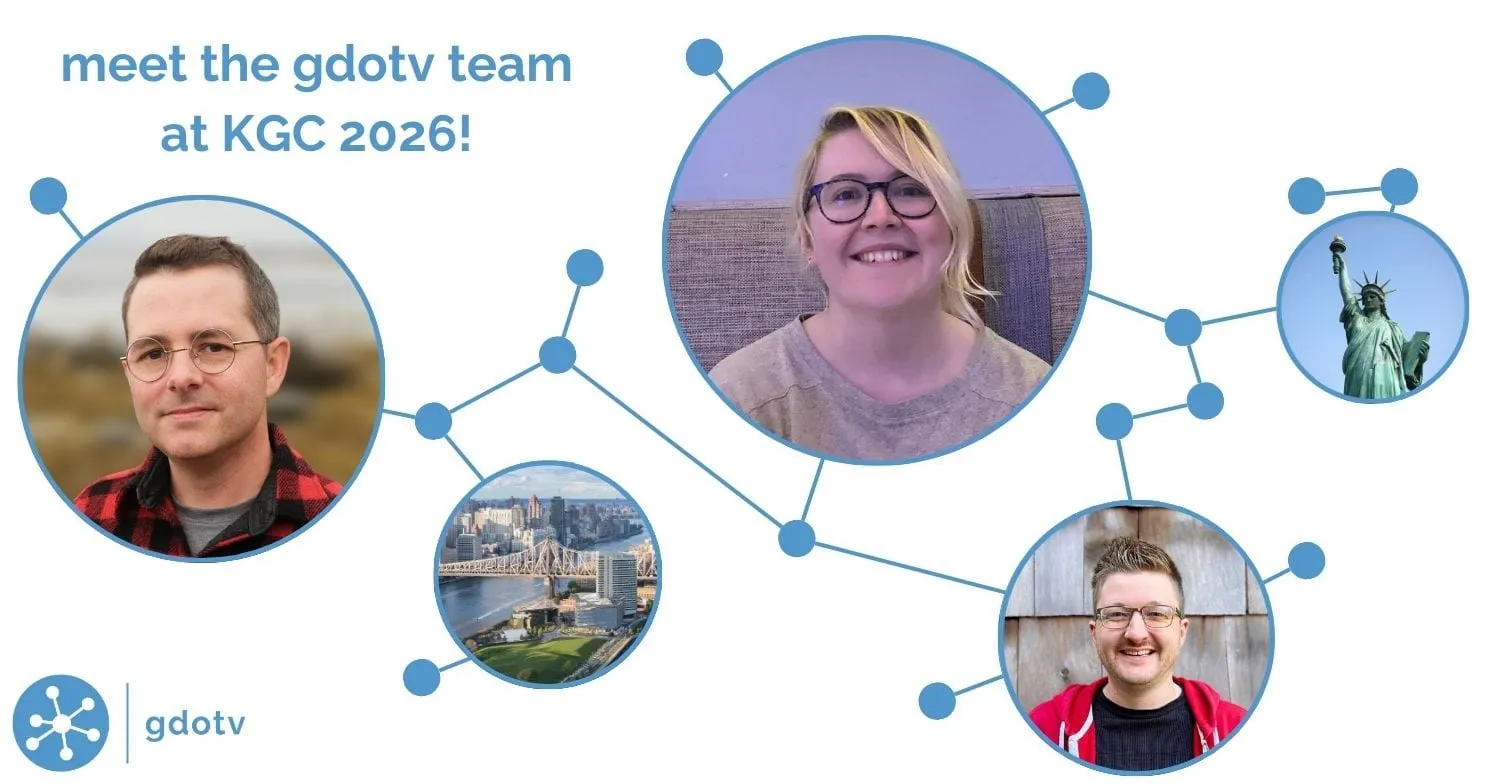
If you or your team are working with graph technology and want to level up your game, come talk with the gdotv team at our booth during this year’s Knowledge Graph Conference.
My colleague Christian Miles – problem solver and graph visualization expert – would be happy to do a deep dive into your use case and figure out which tools might help your team do their best work with graph technology.
Or my colleague Dr. Amber Lennox is a great person for those developer-to-developer convos where you roll up your sleeves and dive into code libraries, app architectures, and data pipelines.
I (Bryce) will be there too to capture interviews and conversations about what’s happening in the graph tech space, how people are solving tough problems with graph thinking, and what’s next on the horizon for the industry. If you’re keen to share, hit me up!
Which Top Talks & Workshops to Attend at KGC 2026
There are always so many great talks, workshops, breakout sessions, and more at KGC that it’s hard to know where to start or which ones to attend.
That said, the KGC organizers only pick good presenters, so whichever sessions you end up going to will still be amazing – but if you need some inspiration, here are my top five suggestions from the KGC agenda to help get you started:
Workshop: OWL or SHACL: A Beginner’s Guide to Making the Right Choice
Monday, May 4th
This workshop co-presented by the Queen of Metadata herself – Tara Raafat – is not one to miss if you have an interest in ontologies and their languages.
Speakers:
- Tara Raafat, Bloomberg LP, Head of Metadata Strategy- CTO Office
- Davide D’Amico, Bloomberg, Software Engineer
Workshop description:
This tutorial introduces participants to the core concepts of OWL and SHACL, using museum data to walk through ontology modeling and shape validation. We focus on practical decision-making: which technology is appropriate in a given scenario and why. Participants will engage with structured hands-on tasks and explore the implications of design decisions through guided discussions.
A special emphasis will be placed on helping attendees understand the distinction between working under the Open World Assumption (OWA), which governs OWL, and the Closed World Assumption (CWA), which underpins SHACL. Through an example-based journey using real-world museum data, participants will experience how these assumptions influence data modeling, validation, and reasoning. By comparing how OWL and SHACL behave when information is incomplete or inconsistent, attendees will gain insight into selecting the right tool for their specific data quality and reasoning needs.
Workshop: Taxonomy Design Best Practices
Tuesday, May 5th
I missed Heather Hedden at last year’s KGC, and I certainly regret it! If you’re a taxonomist, or looking to learn more about the practice of data taxonomy, then don’t miss this workshop.
Speaker:
- Heather Hedden, Taxonomy Consultant
Workshop description:
Ontologies form the semantic framework for knowledge graphs, but to serve the purpose of connecting to content and standardizing metadata, ontologies need to be based on taxonomies and other controlled vocabularies, whose concepts are tagged to content in addition to being linked to data. There has also been a trend of greater integration of taxonomies and ontologies: ontologies are being adopted for wider business use, and taxonomies have been included in the W3C standards with widespread adoption of SKOS (Simple Knowledge Organization System).
While taxonomies are easier to design and create than ontologies, too often they are created without any skill or training, and poorly designed taxonomies yield poor results. This tutorial will cover the basics and best practices in taxonomy design, including: taxonomy and ontology uses, purposes, approaches, standards, and comparisons; sources for taxonomy concepts; wording of concept labels; best practices for hierarchical relationships, and the use of AI in developing taxonomies.
There will be exercises in creating concept labels and relationships, and practice with taxonomy management software.
Conference Tech Talk: Connecting the Dots with Context Graphs
Wednesday, May 6th
My old colleague Dr. Jesús Barrasa is the Indiana Jones of Graphs: He’s an independent thinker across both RDF and LPG graph technologies and if he’s talking on context graphs, then I’m there.
Speakers:
- Stephen Chin, Neo4j, VP of Developer Relations
- Jesús Barrasa, Neo4j, Field CTO for AI
Talk description:
AI systems need more than intelligence; they need context that persists. Without it, even strong models can misinterpret information, lose decision rationale, or repeat the same mistakes. Context Graphs have emerged as a practical pattern for agentic AI: a living graph that captures not only what was retrieved or known, but how context led to actions through tool calls, constraints, policies, and outcomes, stitched across entities and time so precedent becomes searchable.
This talk explores context engineering as the discipline of designing that context layer, and shows how context graphs complement retrieval by enabling multi-hop, structured context assembly (building on GraphRAG-style hierarchical summaries) while improving explainability and evaluation. Attendees will leave with a practical understanding of how to build context pipelines that combine contextual retrieval with persistent memory and provenance, and why context graphs are becoming central to trustworthy, enterprise-ready AI systems.
Conference Tech Talk: Multi-Modal Knowledge Graphs for Agents
Thursday, May 7th
Buckle up because these two co-presenters – Prashanth & David – are a storm-and-a-half of good ideas each, so watching them present together will be a wild ride guaranteed.
Speakers:
- Prashanth Rao, LanceDB, AI Engineer
- David Hughes, Independent, AI and Graph Solution Architect
Talk description:
Most multimodal RAG stacks have a “split-brain” design: embeddings in a vector DB, relationships in a graph DB, and images/video/audio in blob storage. For an agent, that becomes a slow three-hop loop—similarity search, graph traversal, then a network fetch to load the actual frames for a VLM. This talk proposes a Lance-native Multi-Modal Knowledge Graph (MMKG) on lance-context + lance-graph, unifying media bytes, embeddings, and graph topology in one columnar dataset. Nodes become first-class media objects (images, clips, audio segments) stored directly in Lance, enabling zero-copy retrieval during traversal and faster “watch and reason” agents.
We’ll outline a high-level schema: MediaNodes for rich payloads with embeddings, timestamps, and structured metadata; TemporalEdges for explicit ordering (frames/scenes/clips) to support playback and “flashback” queries; and SemanticEdges linking media to entities and concepts. This design enables hybrid retrieval that combines graph constraints with multimodal similarity (e.g., “CEO smiling”), temporal window reasoning (“what happened in the 5 seconds before?”), and other agent workflows. We’ll close with a roadmap of our lance-graph open source project: ingestion utilities and a small set of multimodal graph primitives, and we welcome the graph community to join in the effort!
See: https://github.com/lance-format/lance-graph/issues/91
Conference Tech Talk: RDF 1.2 Status Report
Thursday, May 7th
It’s talks like these that really nail home why you should attend the Knowledge Graph Conference: The Albus Dumbledore himself of RDF – Ora Lassila – will be co-delivering an update about the status of RDF 1.2. Last year, Ora’s talk was so well attended that I was bringing loads of chairs to the room for 30 minutes non-stop and then it was still literally standing room only.
Speakers:
- Jim Hendler, RPI (Rensselaer Polytechnic Institute), Tetherless World Chair of Computer, Web and Cognitive Sciences
- Ora Lassila, Amazon Web Services, Principal Technologist
Talk description:
[Joint proposal with Adrian Gschwend and Pierre-Antoine Champin]
RDF 1.2 is the culmination of years of work on improving the usability of reification in RDF. As the W3C RDF and SPARQL Working Group is nearing the end of its work, it is a good time to summarize what has been done and what the new standard will look like.
Reification in RDF is a historical feature that enables “statements about statements”. It was introduced with the very first draft version of RDF, but has always remained poorly understood and unpopular mainly because it is considered cumbersome (but also because its semantics were never properly defined). About 10 years ago, work emerged under the rubric “Reification Done Right”, eventually becoming the current work stream at W3C (long dubbed “RDF-star”). The improvements can also be seen as a way to provide functionality that Labeled Property Graph advocates have long claimed RDF does not have.
The W3C working group has labored hard to accommodate the different aspirations and viewpoints of “fixing reification”, and last year finally reached consensus. All existing RDF specifications have been updated to introduce a new term type, “triple terms”, into RDF, as well as providing syntactic shorthand for making it very easy to leverage the new feature. In addition, several other details in RDF 1.1 have been “fixed” or updated.
This presentation gives an overview of the new standard and offers an opportunity for the audience to ask any questions they might have.
See You at KGC 2026!
Whether you’ve just bought your first ticket to KGC or you’re a long-time attendee, this year’s Knowledge Graph Conference is sure to be an event to remember. (Psst! Grab your ticket here if you haven’t already.) There will be lots to learn, plenty of new faces to meet, and sure to be lots of conversations on how to better connect and harness the world’s data.
We hope to see you there and talk about the tools that can help that connected data revolution go further!
About the author

Bryce Merkl Sasaki
Former Head of Marketing
Bryce Merkl Sasaki is a writer and editor based in Silicon Valley. A digital nomad and total nerd, he’s wandered the worlds of database and graph tech for more than a decade, covering big moments, interviewing interesting minds, and bringing abstract graph concepts back down to earth. Outside of work, he enjoys hikes with his wife in Northern California and writes on his science fiction novel.