The Weekly Edge: Dgraph Lives, RyuGraph Rises, Gephi Lite & More [31 October 2025]
Discover what’s new in the world of graph technology this week, including a Dgraph acquisition, a new fork of Kuzu, the release of Gephi Lite, and more.

![The Weekly Edge: Dgraph Lives, RyuGraph Rises, Gephi Lite & More [31 October 2025]](https://gdotv.com/wp-content/uploads/2025/10/ryugraph-dgraph-gephi-weekly-edge-31-october-2025.png "The Weekly Edge: Dgraph Lives, RyuGraph Rises, Gephi Lite & More [31 October 2025]")
Discover what’s new in the world of graph technology this week, including a Dgraph acquisition, a new fork of Kuzu, the release of Gephi Lite, and more.
![The Weekly Edge: Kuzu Forks, DuckDB Goes Graph, Cypher 25 & More [24 October 2025]](https://gdotv.com/wp-content/uploads/2025/10/ladybug-graph-database-duckdb-cypher-weekly-edge-24-october-2025.png "The Weekly Edge: Kuzu Forks, DuckDB Goes Graph, Cypher 25 & More [24 October 2025]")
Discover what’s new in the world of graph tech this week, including what’s next for Kuzu, a new book on knowledge graphs and LLMs, Cypher upgrades and more.
![The Weekly Edge: Adieu Kuzu, State of the Graph, NetworkX on Neptune Analytics, & More [17 October 2025]](https://gdotv.com/wp-content/uploads/2025/10/kuzu-archived-networkx-neptune-analytics-weekly-edge-17-october-2025.png "The Weekly Edge: Adieu Kuzu, State of the Graph, NetworkX on Neptune Analytics, & More [17 October 2025]")
Discover what’s new in the world of graph technology this week, including the archiving of Kuzu DB, the State of the Graph project, a new graph agent, and more.
![The Weekly Edge: Graph Tech in Flux, Flexible GraphRAG, KGs for Synthetic Data & More [10 October 2025]](https://gdotv.com/wp-content/uploads/2025/10/graph-data-council-graph-enhance-AI-memory-weekly-edge-10-october-2025.png "The Weekly Edge: Graph Tech in Flux, Flexible GraphRAG, KGs for Synthetic Data & More [10 October 2025]")
Discover what’s new in the world of graph technology this week, including new videos and reads from the Graph Data Council, IEEE, Microsoft Fabric, and more.
![The Weekly Edge: Microsoft Sentinel Graph, Columnar Graph Databases, Euler & More [3 October 2025]](https://gdotv.com/wp-content/uploads/2024/10/microsoft-sentinel-graph-column-oriented-graph-database-euler-weekly-edge-3-october-2025.png "The Weekly Edge: Microsoft Sentinel Graph, Columnar Graph Databases, Euler & More [3 October 2025]")
Discover what’s new in the world of graph technology this week, including Microsoft’s new graph tool for cybersecurity, a knowledge graph hot take, and more.
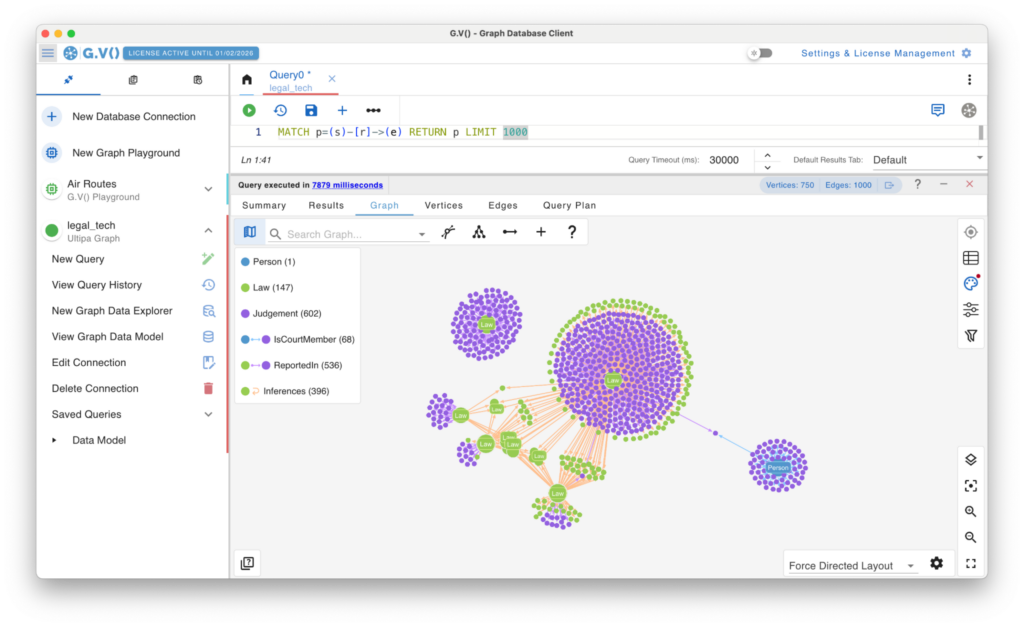
Today marks the release of G.V() 3.40.94. Some significant additions this time around – we now support ISO GQL (Graph Query Language), starting with Ultipa Graph Database!
We’ve also extended our embedded documentation feature, previously only available for the Gremlin query language, to work with Cypher and its many database-specific variants.
And finally, we’ve introduced further user experience improvements, most notably to the settings menu.
We’re excited to welcome yet another new graph database system to the G.V() suite! As of our latest release, we are now fully compatible with Ultipa Graph, Ultipa provides a number of tools for graph database management systems. The newest version of Ultipa Graph, known as Ultipa Powerhouse, is based upon a hybrid structure across multiple server types, with the goal of maintaining both data locality and computational efficiency. Ultipa offers full support for the Graph Query Language or GQL, the first ISO/IEC standardized language for graph databases.
![The Weekly Edge: LDBC No More, Memgraph 3.5, FinCrime (Prevention), & More [25 September 2025]](https://gdotv.com/wp-content/uploads/2025/09/ldbc-graph-data-council-memgraph-fincrime-weekly-edge-25-september-2025.png "The Weekly Edge: LDBC No More, Memgraph 3.5, FinCrime (Prevention), & More [25 September 2025]")
Discover what’s new in the world of graph technology this week, including the end of the LDBC (as we know it), a new graph approach to smart buildings, and more.
![The Weekly Edge: Graphs in Microsoft Fabric, Data Day Texas, EdTech & More [19 September 2025]](https://gdotv.com/wp-content/uploads/2025/09/microsoft-fabric-data-day-texas-edtech-weekly-edge-19-september-2025.png "The Weekly Edge: Graphs in Microsoft Fabric, Data Day Texas, EdTech & More [19 September 2025]")
Discover what’s new in the world of graph technology this week, including a Graphs in Fabric announcement from Microsoft, a rundown of Data Day Texas, and more.
![The Weekly Edge: Infinigraph, GQL in KQL, Youtu-GraphRAG & More [12 September 2025]](https://gdotv.com/wp-content/uploads/2025/09/neo4j-infinigraph-gql-azure-data-explorer-graphrag-weekly-edge-12-September-2025.jpg "The Weekly Edge: Infinigraph, GQL in KQL, Youtu-GraphRAG & More [12 September 2025]")
Discover what’s new in the world of graph technology this week, including 3 big releases from Neo4j, Microsoft Fabric Graph, and ArcadeDB, plus more.